Once an operational diary and cotton farm, Corrie's family's Farm is now a relaxation getaway. It has been in Corrie's family since the land was first developed, in the mid-nineteenth century, if I'm not mistaken (I may be fully mistaken).
Grandma June,whom I've written about before, was born and raised on the Farm, and Ron spent much of his young life and teenage years there. Corrie and all of her close cousins, many growing up in Austin, would make the trek each summer for an extended family trip.
Like with my family's Cabin, we've tried to do something similar: make it a place that grows in our kids' imagination, a place that's theirs as much as ours.
There's space to roam, there're tractors to drive, there's work to be done. It really is a wonderful diversion for city-folk like us.
At this point, I lean towards pictures really only explaining it...
I think Corrie's eyes are shut in the following picture, but the smiles come easily once you've arrived:
Oh yeah, the hammock district, down on 3rd:
The Big Barn, with Ron's newly added pottery studio, is a great place to watch storms roll by fifty miles out, have an auction or two, perform the talent show sketches---during the reunions---or muster for target practice:
Tractor time for the city-boy, Cassius:
Other cool memories for kids: riding in the back of an open trailer:
Father's Day and our anniversary were the same day this year, and while I hadn't showered in a while, a father's day photo-op was in the cards:
Laundry drying the old fashioned way: using the windy-as-hell environs:
That was not an easy accomplishment, putting sheets up in that kind of wind, let me tell you.
Other places to explore, the South Forty, as they're called (as in the "southern forty acres") shows the rolling prairie land that makes up the edge of the Texan canyon country, a beautiful place only a mile away to the west:
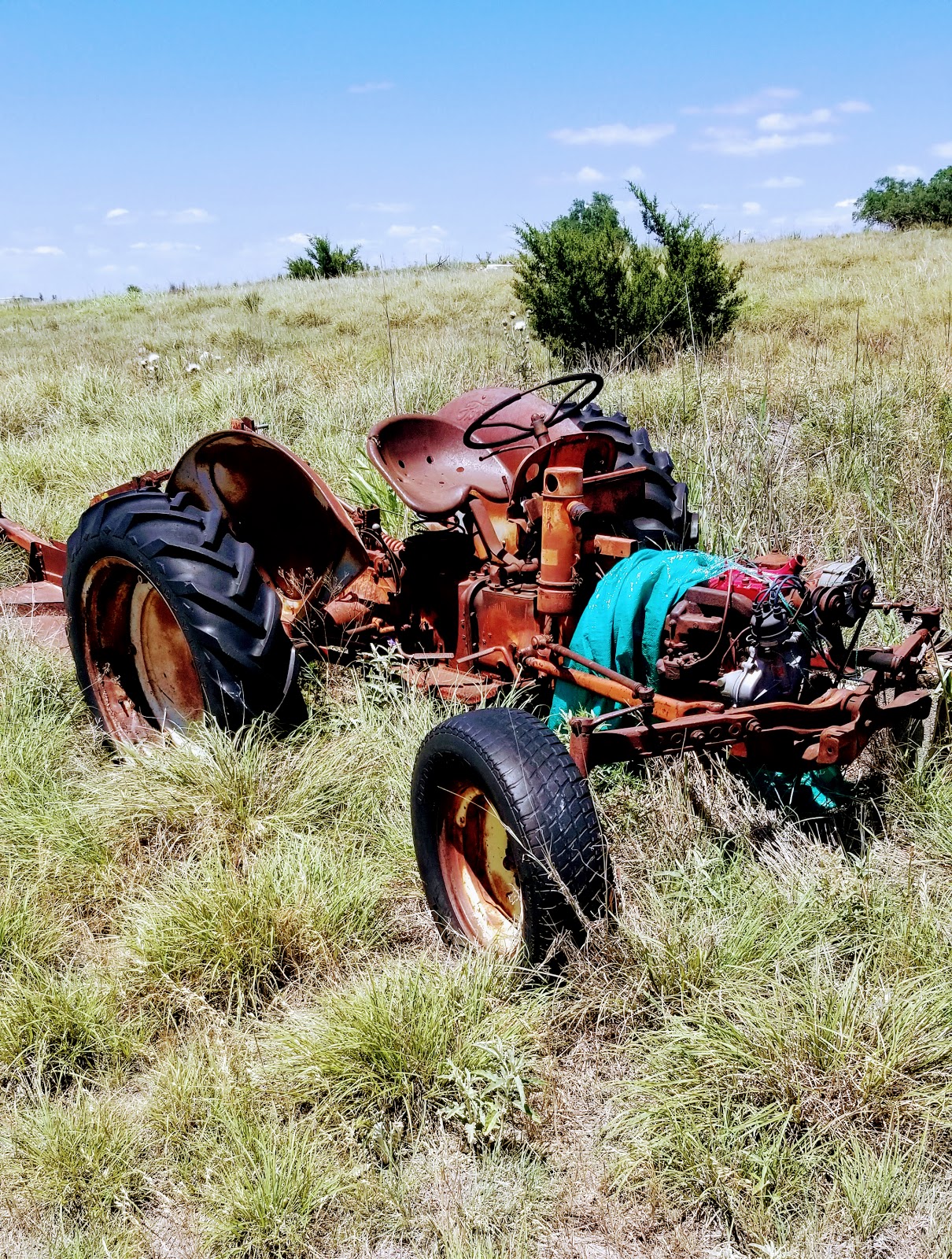
There are two working tractors and a riding lawn mower, and in the old junk yard, you can still find the remnants of farm equipment: old cotton gins and even a tractor or two:
One of the only visible neighbors, a farmhouse a few miles away on a ridge, shows the beauty and remoteness of everything:
Time dilates and the world turns dreamlike. Lighting storms pass by in the distance bringing amazing shows. Other nights it passes overhead, making a show for someone further away, as the rain pours down in enormous sheets and thunder rattles everything. Hanging doors at midnight, hanging swamp coolers at midday. Wasps and hornets everywhere...grasshoppers bouncing away by the dozen with every step.
The reunion had been canceled, and Corrie decided, months ago, that we needed to get the hell out of LA for a while, and planned this trip. She wasn't sure who she wanted to notify, but since Ron basically lives there, he needed to know. News like that couldn't be kept under wraps, and most everyone of Corrie's immediate family made the trip to see us and meet Camille.
We got a few days alone with Ron before the madness, before the brisket and the weekend, and then a single day afterward, after everyone except Ron left and before we started our trek home.
Words can't express the serenity that the Farm provides.
One night, sitting on the covered front porch (on the right below) watching a lighting storm to the north, we watched a large barn owl perched on the thirty-foot tall post below on the left repeatedly swoop down, nab a mouse, mole, or gopher, and return to the post. Just another amazing thing to see while at the Farm:
Sunday, June 28, 2020
Burls and Batting: Family Road Trip, Part 1
We returned a few days ago from our first four-top road trip to the Farm in Clarendon, Texas, an hour southeast of Amarillo, in the panhandle region.
Driving with a four year old and a four month old was not as bad as pop-culture would have you believe. It helps that Cass is rather mature (sometimes and somehow) and Camille is very chill.
Anyway...here's a breakdown of the drive, in map form:
We drove the northern route to Texas, and the southern route back.
Corrie had a trip to Anaheim that was supposed to be over quickly, but took until nearly 1 pm, which changed our scenic route plans to a more direct, high-speed chase of the horizon.
The first night, instead of stopping in Flagstaff after a day playing at Lake Havasu, we powered through 90 more miles to Holbrook, in Northern Arizona.
On Day Two of driving ,we stopped in Albuquerque to have lunch with one of my dad's brothers, Uncle Matt, oddly the only one of my dad's nine siblings Corrie had yet to meet in our nearly twenty years of being together, before keeping on for points east.
Corrie's dad, Ron, has been intermittently living on the Farm, and texted us as we got close to pick up beer before arriving, but we hit Amarillo at 9 pm (having lost two hours to time zones)(and traveling with kids, of course), and were out of luck due to pandemic-mandated closing times.
In the past, I may have made a bunch of posts about a trip like this, but I don't have the inclination now.
The Farm is a magical place where stress dissolves away within moments of arriving, and staring off at the prairie as storms roll by, or just chilling in the shade, is more entertaining than many, and most, things.
The first day was better than the second in the car, but even that wasn't so bad. Nineteen hours or so, over two days, surprisingly chill. No bathroom accidents, which was a concern of young parents. (Note: while I wouldn't qualify Corrie and I as young, per se, the kids are, as as such, we're still in early stages of parenting.)
Cass, also, didn't spend the majority of the time on the tablet, which I'm very proud of. He did spend some time on it, just not the majority of time.
Driving with a four year old and a four month old was not as bad as pop-culture would have you believe. It helps that Cass is rather mature (sometimes and somehow) and Camille is very chill.
Anyway...here's a breakdown of the drive, in map form:
We drove the northern route to Texas, and the southern route back.
Corrie had a trip to Anaheim that was supposed to be over quickly, but took until nearly 1 pm, which changed our scenic route plans to a more direct, high-speed chase of the horizon.
The first night, instead of stopping in Flagstaff after a day playing at Lake Havasu, we powered through 90 more miles to Holbrook, in Northern Arizona.
On Day Two of driving ,we stopped in Albuquerque to have lunch with one of my dad's brothers, Uncle Matt, oddly the only one of my dad's nine siblings Corrie had yet to meet in our nearly twenty years of being together, before keeping on for points east.
Corrie's dad, Ron, has been intermittently living on the Farm, and texted us as we got close to pick up beer before arriving, but we hit Amarillo at 9 pm (having lost two hours to time zones)(and traveling with kids, of course), and were out of luck due to pandemic-mandated closing times.
In the past, I may have made a bunch of posts about a trip like this, but I don't have the inclination now.
The Farm is a magical place where stress dissolves away within moments of arriving, and staring off at the prairie as storms roll by, or just chilling in the shade, is more entertaining than many, and most, things.
The first day was better than the second in the car, but even that wasn't so bad. Nineteen hours or so, over two days, surprisingly chill. No bathroom accidents, which was a concern of young parents. (Note: while I wouldn't qualify Corrie and I as young, per se, the kids are, as as such, we're still in early stages of parenting.)
Cass, also, didn't spend the majority of the time on the tablet, which I'm very proud of. He did spend some time on it, just not the majority of time.
Burls
I learned a few things on this trip, and I liked the way they sounded together in my head when mulling over the title of this trio of posts about our road trip.
The first thing is a burl. When the bark of trees grows irregularly and turns knobby, that's a burl:
There was a nice burl on one of the trees where a hammock was set up, and Ron joked that we were waiting for it to get bigger before cutting them off and making things with the burled wood, since it looks very nice.
Batting
Another thing I learned about was batting. I helped Ron change the bats on the swamp cooler. When he first mentioned it, I thought he was talking about batteries because I'm an ignorant city-boy.
Batting is a shredded product that is wedged like insulation inside a swamp cooler. When it's old and terrible, it must be replaced, and that was one of the jobs we needed to do while on this trip.
The old batting was an absolute nightmare. It was dirty and cancerous to breathe (I'm sure). The new stuff looked so much more normal, but still a terrible environmental product. It looks like the shredded stuff is actually wood, instead of a totally industrial product:
It's brittle and crunchy, and working with it makes one appreciate the manual labors and working with your hands.
We even installed the swamp cooler, which makes you feel like a helpful person, a helpful member of the team.
In any case, we made it safely to the Farm, our first week-long respite from the cramped city life we normally live through.
Friday, June 5, 2020
Overly Successful Invaders
Far from their natural habitat, two species of animal are wreaking havoc on environments that have no natural defenses, and the results have been devastating. In a cruel twist, each of the animals has a name that is both cool and simple.
Fire ants don't bite in the sense that they break the skin with a painful mandible-strike. Their mandibles are quite strong, but they use them to grip whatever it is they're going to attack, and then they use their stinger on the end of their abdomen. Since it doesn't detach, they can make multiple strikes, with each one delivering venom.
With no natural predators, fire ants have started their slow march away from Alabama towards points east, west, and north. They are essentially unstoppable. Scientists have been working on how to stop the invasion...and then gave that up for the possibly possible goal of controlling the numbers. In this they found a glimmer of hope.
It turns out there's a specie of parasitic fly that only preys of fire ants. The reason the ants can make a raft is because of a substance in their exoskeletons, and it is for this hard substance that these flies have developed weaponry. The fly attacks, lays a single egg in the thorax of the ant, the egg grows into a maggot, migrates to the ant's skull. It takes over the ant's brain, eventually releases an enzyme that decapitates the ant, then flies out of the downed skull.
Each fly has about 200 eggs. It looks like introducing these flies to colonies can bring down the numbers by something like 80 to 90%. That sounds great, but: 1) there are so many colonies of these invaders; and 2) it takes a concerted effort to introduce the fly, since they're not native to North America either.
If you, too, can hear Seymour Skinner inn your head saying, "Well that's the beauty of the plan: in the winter the gorillas just freeze to death," as the end result of new waves of introduced species, fear not apparently. It is assured that the flies only attack fire ants, mainly because, the thinking goes, the egg-delivery method specifically evolved to target the species of fire ants that developed that buoyancy exoskeleton substance.
Fire Ants
Originally from the Amazon, these ants caught a ride in South American ballast holds and once dumped, used their amazing ability to form colony-sized rafts and floated onto the American shores in Mobile Alabama.
Capable of producing nine million new ants a day, colonies tend to balloon to forty-million and live in in enormous underground labyrinths that they excavate. The tunnels keep the ants insulated from both heat and cold, and stretch down to the water table, so the colonies are also resistant to drought.
Fire ants don't bite in the sense that they break the skin with a painful mandible-strike. Their mandibles are quite strong, but they use them to grip whatever it is they're going to attack, and then they use their stinger on the end of their abdomen. Since it doesn't detach, they can make multiple strikes, with each one delivering venom.
With no natural predators, fire ants have started their slow march away from Alabama towards points east, west, and north. They are essentially unstoppable. Scientists have been working on how to stop the invasion...and then gave that up for the possibly possible goal of controlling the numbers. In this they found a glimmer of hope.
It turns out there's a specie of parasitic fly that only preys of fire ants. The reason the ants can make a raft is because of a substance in their exoskeletons, and it is for this hard substance that these flies have developed weaponry. The fly attacks, lays a single egg in the thorax of the ant, the egg grows into a maggot, migrates to the ant's skull. It takes over the ant's brain, eventually releases an enzyme that decapitates the ant, then flies out of the downed skull.
Each fly has about 200 eggs. It looks like introducing these flies to colonies can bring down the numbers by something like 80 to 90%. That sounds great, but: 1) there are so many colonies of these invaders; and 2) it takes a concerted effort to introduce the fly, since they're not native to North America either.
If you, too, can hear Seymour Skinner inn your head saying, "Well that's the beauty of the plan: in the winter the gorillas just freeze to death," as the end result of new waves of introduced species, fear not apparently. It is assured that the flies only attack fire ants, mainly because, the thinking goes, the egg-delivery method specifically evolved to target the species of fire ants that developed that buoyancy exoskeleton substance.
Lion Fish
Originally from the Indo-Pacific swath of ocean, the beautiful and venomous lion fish were dumped off the coast of the eastern United States a few years back, as well as somewhere in the Mediterranean. The problem here is that 1) they are wildly voracious, and devastate local fish populations; and 2) they reproduce quickly and face no predation in the Atlantic nor the Caribbean, where they have arrived.
They destroy reefs by eating all the fish that keep the algae on the coral in check, and once the algae-eating fish are gone, the corals tend to get choked out.
In Honduras, an effort to teach sharks to eat them has met with mixed results. On the other side of the planet, both sharks and groupers prey on lion fish, but in the Caribbean and the Atlantic, the sharks and groupers there never had them to prey on throughout theur evolutionary history, and while neither seem to be bothered by their poisonous dorsal spines, they also don't seem too interested in eating them.
The last line of predator defense against the lion fish's total take-over of the reefs of the Caribbean and Carolina's, is, eh, us. Humans.
There is a concerted effort to raise awareness of the destruction wrought by this invader by way of eating them. By popularizing the said-to-be-delicious meat of the lion fish, some order is hoped to be returned to devastated reef systems. It's open season on lion fish.
I can't stress that enough: IF YOU GO DIVING OFF THE SOUTH EASTERN US, OR IN THE CARIBBEAN, KILL AS MANY OF THESE AS YOU SEE. It's as easy as that.
Postscript: Clearing Urchin Barrens
Similar in the sense that unchecked population growth is devastating, but different in the sense that they're not invasive, sea urchins can leave eerie landscapes where kelp forests used to thrive:
A before an after picture of urchin barrens and a kelp forest. The time it takes to go from the top picture to the bottom picture is not long: less than a month, actually.
I was reminded of this topic for a postscript because of the tact that some marine scientists took to help bring the kelp forest back in one place off the coast down here in LA. The normal urchin predators had been few and far between in the urban coastal scene south of Santa Barbara, so a couple of guys went out with hammers and smashed open every single urchin they could find. It was a massacre.
Since they're not fast swimmers like lion fish, it was a little more straightforward. In five days there was a noticeable difference; within ten days holdfasts were supporting growing kelp; within three weeks it was a healthy, if young, kelp forest; and by day 28 the urchin barren was a distant memory.
It helps that kelp can grow two to three feet a day.
Sometimes it feels like a terrible ideology can be an invasive specie, and eradication seems both wildly necessary and practically impossible. At least with an invisible and indifferent invader, time is on our side, but the future seems like it will depend on how we deal with a terrible ideology.
Wednesday, June 3, 2020
Curfews and Quarantines
The day started off so promising...
Last week I learned my daughter takes to the sun more like me than her mom or brother, and this week I joined Cass frolicking in the water.
In the middle of the intersection of LB Blvd and Broadway a person with a bullhorn bellowed about institutional racism and then start a call-and-response chant. It went like that for a while as the crowd slowly grew.
Shuttered for the storm...
We were only chanting...I mean, we marched nearly 30 k deep in downtown LA during the STRIKE, and I never saw any boarding...
Most either had Black Lives Matters papers stapled to them or were spray-painted with messages to the same effect.
At the intersection of Pine and Broadway there were more chants, angrier this time and directed at the cops chilling and keeping an eye on things.
Once I learned that Beachwood Brewery was also closed, I figured it was a sign. A phalanx of new people, an influx of protesters came in from points east, and I rejoined the efforts:
Someone walked through the crowd, a crowd where nearly everyone wore masks except when they took them off to smoke joints or blunts, shouting new directions: "Pine to Ocean! Down Pine to Ocean..."
Off the mob walked, moving about like an amoeba, as marching crowds tend to do. I jumped ship again at Pine and 1st, a block north of Ocean, and headed home. Surely this had been enough sun for me, and my feet were chapped and still sandy.
I was home for a few minutes when my phone, and Corrie's phone, started blowing up with what we know as the Amber Alert message:
1: At the Beach
On the last day of May in this bizarro-world year of 2020, we gathered up the kids, some beach towels, and our walking masks, and headed down to the beach. This was our second foray to the seaside since they were reopened last week.
Last week I learned my daughter takes to the sun more like me than her mom or brother, and this week I joined Cass frolicking in the water.
After what seemed like hours, but was more like 80 minutes, we decided to wrap it up and head towards home. We'd heard that restaurants had been given the green light to reopen, depending on them following a strict social distancing/mask/glove-or-sanitizer regimen.
We decided to see if the taco shop we probably went to for our last sit-down restaurant meal back in March was one of the brave places that was attempting to open. In the two-and-a-half months since we'd been on Safer-at-Home directives we'd patronized them; we went with the family style meat-by-the-pound style of ordering.
2. So Weird Precisely Because it was "Normal"
We arrived at the Long Beach Taco Company and took seats in the shade outside. We ordered tacos, beer, ceviche, and a quesadilla for the Boy. As we ate, the lone group on the patio, something strange happened.
And it was strange because it was so normal of a past life. Corrie and I have noticed over the years of our being together, that we somehow arrive at restaurants as the first wave of the rush. I have no idea how or why this happens. And because we've been together for nearly twenty years (!) and have plenty of restaurant dining experience, I can say that this bizarre phenomenon occurs more than regularly.
We show up at a slow or quiet dining room, and when we leave, it will be busy and starting to back the kitchen up.
And this happened Sunday. Groups started to trickle into the patio, and eventually it was full, or as full as it could safely be in this moment. Going inside to ask for some foil and the check showed that they'd started seating people inside.
It was almost like a regular weekend day. Obviously you couldn't wear a mask while you stuff stewed meat wrapped in housemade tortilla into your gob, or chug beer, so for a brief few minutes, life resembled what it had before the invisible and indifferent menace swooped down into our lives.
But, across the street, another story was happening, a story of a weary town that'd seen much in its life and knew a storm was coming.
As we ate we watched a muralist across the street painting a pair of faces moments away from kissing, lips poised and eyes shut. Very stylized and enormous on the wood, he was using only black and white paint, and applying it with rollers once he detailed out the eyes.
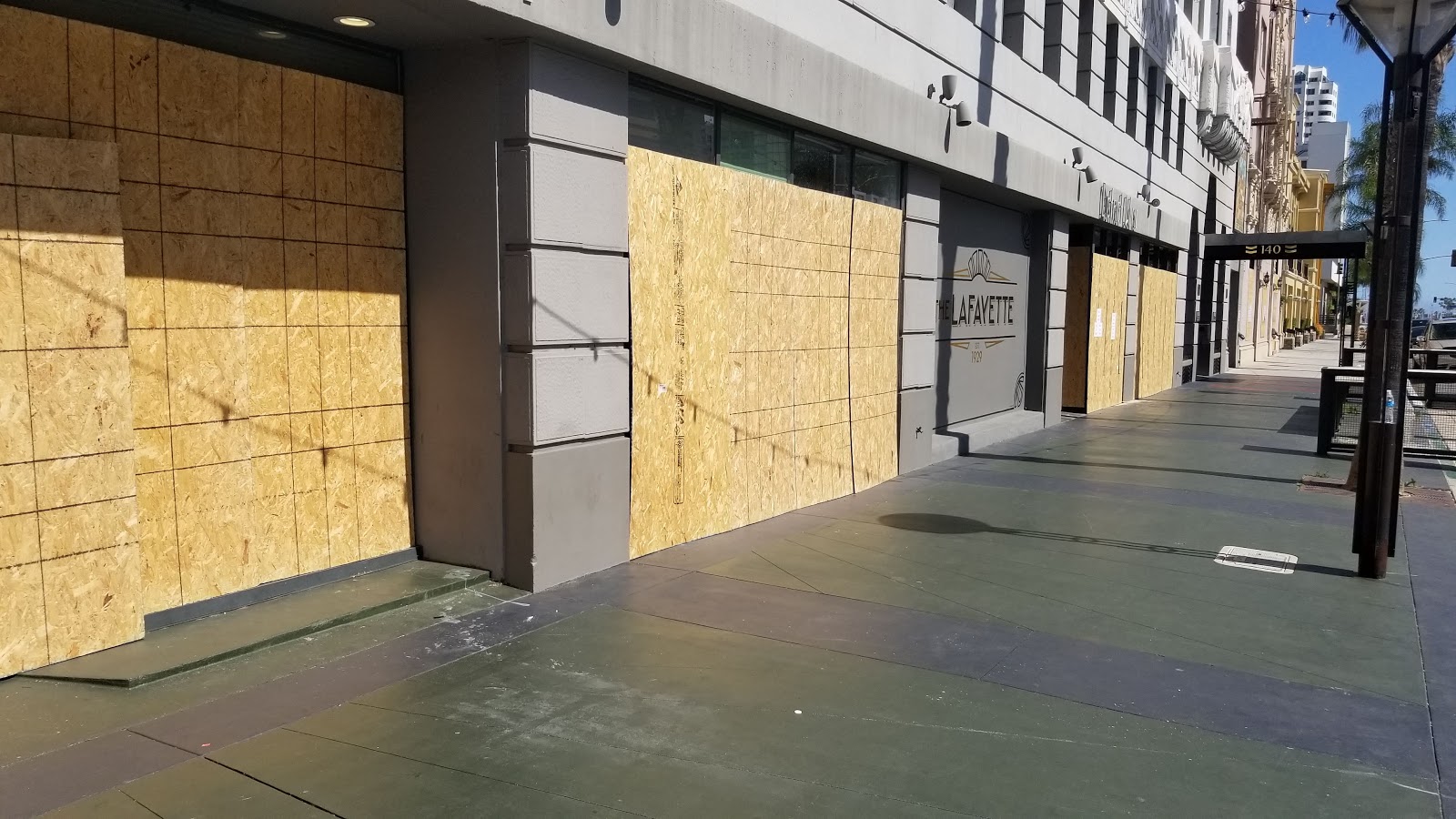
Painting on wood? I thought...and realized that the gaggle of folks over there at the glass-fronted shops across the street weren't all watching him, rather they were affixing the 1-inch thick sheets of plywood to the fronts of the stores, shielding the inside of the businesses.
Up and down the north side of 1st St the boutique denim shop, the coffee shop, the BYOC (bring your own container) store, the boutique sneaker store...all boarding up like a hurricane was coming.
I looked at Corrie and said, "Boards?"
She said that the George Floyd protest was later in the day. They were probably just preparing. She'd mentioned before we left for the beach that at 3 pm the protest and rally in downtown Long Beach was to muster and commence, and I'd thought about attending and bringing Cassius along. It would be a good learning experience for him.
I've been a part of many protests and marches, and even parades, and the need to board up store fronts never materialized. Maybe as far as I knew, anyway.
We left a full and busy taco shop and headed home. Our route had us skipping the Broadway/Linden intersection, and the crowds were starting arrive, heading west along 1st St and Broadway, a block north. They had protest signs and masks, and the vibe was catharsis mixed with cautious pangs of hope.
We cheered them along as we headed north along Elm and they streamed west, as the muster point was Broadway and Long Beach Blvd, a diagonal block away from us.
3. The Peaceful Part,
But Some Things are Very Weird
I had to carry Cass home the last stretch of the way, which showed just how exhausted and sunblasted he was. Me too, I thought, and add in the high-powered beers I drank at the taco shop, and I figured I would make a solo trip to the protest, and even then, it wouldn't be for long.
I didn't need more sun.
The crowd looked smallish and in good spirits, but people were still coming:
In the middle of the intersection of LB Blvd and Broadway a person with a bullhorn bellowed about institutional racism and then start a call-and-response chant. It went like that for a while as the crowd slowly grew.
After a while I felt like my extended time in the sun was coming to an end, and I decided to go get some beer for the house and head home. Walking down Broadway towards the beer shop I've been visiting during the pandemic, as well as towards Vons, I caught glimpse of a scene we'd only slightly felt before:
Shuttered for the storm...
We were only chanting...I mean, we marched nearly 30 k deep in downtown LA during the STRIKE, and I never saw any boarding...
Most either had Black Lives Matters papers stapled to them or were spray-painted with messages to the same effect.
When I got to Vons, I could tell something was very awry:
The grocery store needs barricading?
As I moved back towards home, it looked like the group was going to start marching east along Broadway, so basically following my trek to find alcohol. I joined the march near the front. It soon became apparent that the crowd had gotten the wrong message, and four-fifths of the people had started marching the opposite way, towards Pine and the heart of downtown Long Beach.
At the intersection of Pine and Broadway there were more chants, angrier this time and directed at the cops chilling and keeping an eye on things.
Once I learned that Beachwood Brewery was also closed, I figured it was a sign. A phalanx of new people, an influx of protesters came in from points east, and I rejoined the efforts:
Someone walked through the crowd, a crowd where nearly everyone wore masks except when they took them off to smoke joints or blunts, shouting new directions: "Pine to Ocean! Down Pine to Ocean..."
Off the mob walked, moving about like an amoeba, as marching crowds tend to do. I jumped ship again at Pine and 1st, a block north of Ocean, and headed home. Surely this had been enough sun for me, and my feet were chapped and still sandy.
I was home for a few minutes when my phone, and Corrie's phone, started blowing up with what we know as the Amber Alert message:
Curfew? This had been a mostly pleasant demonstration. Some of the chants I now fully adhere to, like "Abolish Police!" That one seems fit. The time is now to reimagine peace keeping as a combination of social work, drug dependence counseling, and major crime unit investigations (like sex trafficking and corporate money laundering).
Turns out I'd left a little early.
4. The Chaotic Part
Helicopters had been a presence at all stages of the protest and march, and we're generally more used to hearing helicopters under regular circumstances in our neighborhood, so the constant drone in the background during our late afternoon dinner making time wasn't necessarily a surprise.
The sirens, though, were a little weird. Roaring all over the place, getting closer to the apartment, getting further away, getting closer...they were all around and loud. That was...unusual, but not totally insane.
I saw a neighbor of mine as I walked with Camille and Cass ran around before dinner, out on our front walkway area. This dude looked stressed the-f out. I called out to him. He was shaking his head, saying, "These looters, man...the shops downstairs...man...just, be careful..." and he took off down the stairwell.
Looters. I figured something like that had happened. At this point I was unaware of how things had unfolded.
Back inside I mentioned to Corrie that the neighbor had seemed stressed about looters, to which Corrie reassured me that with the sprinkler system intact, we'd most likely not burn to death.
FIRE? Not something I'd been thinking about. Until then, of course.
A few minutes later as I got some things ready for dinner, it sounded like someone was about to be killed on the street outside. I went to the back balcony to have a look-see, but the trees blocked my view. Eventually they came into view: one dude with a rod or a pipe was mostly surrounded by folks trying to shove him along, to shoo him away.
That's when I realized what I was looking at: one person was ready to start bashing in windows on the businesses in one of the buildings across the street, ready to start a looting frenzy, but the neighborhood people weren't having any of it.
After dinner getting the kids ready for bed, the sirens and helicopters were now unbearable and made conversation difficult. Cass made it down, and Corrie went upstairs to check on the Simpsons rerun that would air n broadcast Fox 11 (we're old-fashioned), I went with a groggy Camille back into the bedroom.
More chaos was coming in from the street. When Corrie showed up I handed Cam to her and went out to the balcony to have a serious look-see, where I could crane over the railing facing the dying sunlight.
Down below was a group of people I recognized: shopkeepers from the building's shops, and the neighbor from before; they were all lined up holding bats and rods and pipes. Briskly walking and jogging up the street towards them, towards us, away from downtown were dudes. Bad dudes, dudes that looked like they were up to no good. They also had pipes and bats.
They were met with a healthy dose of Move-the-Fuck-Along, and along they went, dissolving into the neighborhood.
Corrie came in to put the nearly asleep baby down in the crib and I headed upstairs to check on the Simpsons. On Fox 11 at that exact moment was a cop, an LBPD sergeant talking right in front of the former Big 5 store at 4th and the City Place shopping promenade, maybe a thousand feet from the apartment. My neighborhood was on TV at that instant.
A reporter was asking the cop, "How come rounding the looters up has proven so difficult?" And he looked around and said, "Well, they just dissolve into the neighborhood..." I just said that, I thought to myself.
To the west, north, and east of the City Place shopping center is residential neighborhood. To the south is more commercial, and eventually the Pike, which is where the group I had been walking with had been heading when I peeled away and went home.
I had literally seen the looters am-scraying into the woodwork.
Seeing your neighborhood on the news, or television in general, is always surreal. I found an article online that had been pretty recently updated, and it filled in some of the gaps for me, with information on the Pike destruction. Two things about the article:
- It was written (partially) by my boy Ruben! Go Rubes!
- It made me realize that had we not gone to the beach, Cass and I would most certainly have stuck with the march all the way to the Pike, and eventually I would have had to have grabbed him and ran when the windows started getting smashed.
Talking to Corrie later, I looked up and saw another surreal sight: the business where I get my prophylactics was on my television screen:
The helicopters and sirens drowned out whatever we put on, but we were trying to process the realities and weren't going to be able to focus on anything with any serious concentration.
It was after 1 am when the helicopters and sirens finally stopped sounding, and when that came about, it was cemetery silent. No cars, no bikes, no homeless people talking or arguing, no drunks loudly professing their love for banal things---total silence.
5. The Next Day
Some stores are still boarded up, and the grocery store's pandemic-limited hours are even more limited, as on Monday it was done letting people in around 12:30. Yesterday, Tuesday, Cass and I went shopping at 9 am.
Monday morning, on the way to daycare, I saw lots of people in masks carrying brooms, dustpans, and trash-bags. They were out en masse looking for places to clean up. The volunteerism was very high, and it leaves you with a sense that there is hope for this broken and failed nation.
Perspectives
I'm not one to proffer blanket condemnation of looters. Ii think this society s a little too consumerist anyway, and property can be replaced and/or fixed.
The annoying thing for me about it in this moment, and something that reinforces the idea that bricks were strategically planted to encourage the few who felt like busting stuff up, is that the looting hijacks the narrative that we as a country need to have a tough conversation about race, and specifically about the two separate worlds that are being policed by the same people.
To even acknowledge that that type of conversation needs to be had, we have to gather by the tens-of-thousands across the nation shouting at the top of our lungs. But the story the next day is about people liberating resources looting from their own neighborhoods. On and on it goes.
And the White House resident threatens to send the military to the city to "deal" with protesters of social injustice. Maybe we should all just show up at the capital with machine guns.
That guy seems to think that's fine, right?
Oh wait, how's that pesky pandemic doing? Oh yeah...over 100 k dead and over 40 million out of work.
Stopped worrying about that for a second, didn't we?
JUSTICE FOR GEORGE FLOYD! JUSTICE FOR BRIONNA TAYLOR! HOW FAR AWAY ARE THE FIRES OF REVOLUTION?
Tuesday, May 19, 2020
Does the Virus Sleep? Pandemic Conversations with a Little Boy
I'd been so used to calling my son a toddler that it'll take some getting used to maintain calling him a "little boy." No way, something tells me this will all be over in a blip. He's huge, been using the toilet easily for a few weeks, and will be four years old in a few weeks. He's no longer a toddler.
As children can be, he's full of questions. On the way to daycare when I'm listening to NPR I'm usually surprised with how well he listens. Who knew? He can pick out the word "virus" like a moth can a flame. He's been told that the virus is the reason we can't go to playgrounds anymore, for a little bit. The virus is also keeping us from hanging out with friends, or going to the beach, or heading to our favorite pizza place to sit and have dinner.
"Is the virus in your comic shop?"
I mean, I hope not, but the presence of the virus itself is not the reason that the comic shop downstairs is closed. It's complicated. We have to be alone to beat it, we have to stop it from being able to spread, and to do that, everyone has to hide in their homes.
The mighty moon-walking, genome-sequencing, solar-system-leaving Homo sapiens, finding all they can do against a microscopic enemy is run home and hide.
"Does the virus sleep?"
Nope. It doesn't sleep or eat or even have babies. See, you're made up of trillions of cells, cells make up every organ you have, like your tummy, or muscles, or brain, and even your skin. Viruses are so small that they can sneak into one of your cells. Then they find your mitochondria---that's what powers that cell---and hijack it. Instead of making fuel for your cell, the powerhouse makes copies of the virus, until the cell, packed full, bursts open, sending viruses everywhere.
Some people think that viruses aren't even alive. They just snip out a bit of RNA and replace it with their own.
"Does the virus have a mouth?"
Since they don't eat, they don't have mouths.
"Does the virus have a butt to poop out of?" (This is the funniest comment ever, apparently.)
Since they don't eat, they don't make any poop that needs a butt to pooped out of. (Until this.)
Is the reason so many white folks are having a hard time with this entire extended lockdown because it precisely is an invisible enemy, so tiny that even one of our trillions of cells dwarfs it, so dangerous that even our best weapons are meaningless against it? Are white folks really than accustomed to getting their way that being told to chill out for a few months is enough to jack them all up?
IT IS NOT INHERENTLY MALICIOUS. IT DOES NOT CARE THAT IT CREATED A PANDEMIC. IT DOES NOT UNDERSTAND WE HAVE AN ELECTION THIS YEAR, OR EVEN WHAT ELECTIONS ARE.
I had a union zoom meeting last week, for which I spent the entire time holding my daughter because of the time of day. One of the guys from the meeting was gung-ho about returning to work. Common dismissive refrains came from him: This is just like the flu, and We're all going to get it at some point, and the general ethos of many a thousand people, We have got to get back to work.
I just wanted to ask him: Are you okay with killing someone's grandma because you've got to go back to work so badly? And, bigger picture, is it morally okay to kill somebody just because you didn't know you were doing it?
There are no good answers here, folks. At a Christmas Eve party five months ago a family friend said, "Well, at least this sociopath hasn't had any true disasters to deal with." Welp, here's an opportunity to shine...
How's that working out for everyone?
George Packer nails it in his opening piece in this month's Atlantic.
Historic and colossal mismanagement is harder to discuss with a little boy than whether or not viruses are alive.
"Is the virus at Diz-nee-land?"
As children can be, he's full of questions. On the way to daycare when I'm listening to NPR I'm usually surprised with how well he listens. Who knew? He can pick out the word "virus" like a moth can a flame. He's been told that the virus is the reason we can't go to playgrounds anymore, for a little bit. The virus is also keeping us from hanging out with friends, or going to the beach, or heading to our favorite pizza place to sit and have dinner.
"Is the virus in your comic shop?"
I mean, I hope not, but the presence of the virus itself is not the reason that the comic shop downstairs is closed. It's complicated. We have to be alone to beat it, we have to stop it from being able to spread, and to do that, everyone has to hide in their homes.
The mighty moon-walking, genome-sequencing, solar-system-leaving Homo sapiens, finding all they can do against a microscopic enemy is run home and hide.
"Does the virus sleep?"
Nope. It doesn't sleep or eat or even have babies. See, you're made up of trillions of cells, cells make up every organ you have, like your tummy, or muscles, or brain, and even your skin. Viruses are so small that they can sneak into one of your cells. Then they find your mitochondria---that's what powers that cell---and hijack it. Instead of making fuel for your cell, the powerhouse makes copies of the virus, until the cell, packed full, bursts open, sending viruses everywhere.
Some people think that viruses aren't even alive. They just snip out a bit of RNA and replace it with their own.
"Does the virus have a mouth?"
Since they don't eat, they don't have mouths.
"Does the virus have a butt to poop out of?" (This is the funniest comment ever, apparently.)
Since they don't eat, they don't make any poop that needs a butt to pooped out of. (Until this.)
Is the reason so many white folks are having a hard time with this entire extended lockdown because it precisely is an invisible enemy, so tiny that even one of our trillions of cells dwarfs it, so dangerous that even our best weapons are meaningless against it? Are white folks really than accustomed to getting their way that being told to chill out for a few months is enough to jack them all up?
IT IS NOT INHERENTLY MALICIOUS. IT DOES NOT CARE THAT IT CREATED A PANDEMIC. IT DOES NOT UNDERSTAND WE HAVE AN ELECTION THIS YEAR, OR EVEN WHAT ELECTIONS ARE.
I had a union zoom meeting last week, for which I spent the entire time holding my daughter because of the time of day. One of the guys from the meeting was gung-ho about returning to work. Common dismissive refrains came from him: This is just like the flu, and We're all going to get it at some point, and the general ethos of many a thousand people, We have got to get back to work.
I just wanted to ask him: Are you okay with killing someone's grandma because you've got to go back to work so badly? And, bigger picture, is it morally okay to kill somebody just because you didn't know you were doing it?
There are no good answers here, folks. At a Christmas Eve party five months ago a family friend said, "Well, at least this sociopath hasn't had any true disasters to deal with." Welp, here's an opportunity to shine...
How's that working out for everyone?
George Packer nails it in his opening piece in this month's Atlantic.
Historic and colossal mismanagement is harder to discuss with a little boy than whether or not viruses are alive.
"Is the virus at Diz-nee-land?"
Things I've Learned on Quarantine
1. My Son's Breakfast Game is Amazing
In these weeks that I haven't been needing to drive to work, I've been able to be up early with my boy and make him breakfast before taking him to daycare/school. It operates out of a home with less than a dozen kids and provides both him and us our only social interaction, at drop off and pick up.
With little incentive to rush out the door, besides trying to have a modicum of regularity in my own work schedule, I'm usually game to let him eat what he wants for breakfast. Many mornings go like this:
- Bowl of Cheerios
- Second bowl of Cheerios
- Waffle from our homemade batter
- Second waffle
- Fried egg
- Second fried egg
- Third fried egg
By the second fried egg I'm usually like, "You want another egg? Well, hell yeah!" The third is foregone conclusion.
My son turns four next month, and I expected it to take another dozen years before I was exhausted just watching him eat.
2. The Origins of Friday the 13th as a Negative Idiom
I was caught up in some twenty-five minute documentary on Curiosity Stream, a very worthy quarantine subscription purchase (twelve bucks for the year?!?), about Parisian secrets, and it was the Knights Templar episode. I wasn't interested in many of the other episodes, but I didn't know so much about the Knights Templar, and the time commitment was low, so I hit play.
So...a group of, eh, mercenaries tried to protect Christian pilgrims on their way to the Holy Land. That area was home to lots of non-Christians, so it was a serious gig. Eventually the Knights were given a temple as a headquarters (maybe I'd had too many gin and tonics by this point?), which led to their name.
Anyway, by 1100 they were hired by the French king to be a special protective force and given some land right outside of Ile de la Cite, the island in the Seine where Notre Dame sits today. Historically some scholars think the origin of Paris itself, starting around 200 CE, was on this island.
In the centuries that followed, the Knights started buying the surrounding land, amassed a ton of wealth, and started lending money. They even used their power and fame to help travelers, becoming the first recognized international backer of currency: if you lived in Paris and wanted to visit Genoa, you could drop off money at the Knights Templar's headquarters and they would write you a note promising to back the equivalent amount of Genoan currency. This was a major breakthrough in traveling, as now people could travel without carrying their own money and be susceptible to bandits.
By 1303, the French king had grown weary of the wealthy and powerful Knights, how they'd purchased enormous swaths of Paris, and mostly about how they had a little too much independence. In the middle of the night, on Friday the 13th of October, the king had his men kick down the doors to the unsuspecting Knights and swept them all away to jail, thereby seizing their assets. Within a decade nearly all were burned at the stake.
There remains, on the tip of the Ile de la Cite, in the proverbial shadows of Notre Dame, a marker of the last knights burned at the stake rests.
3. There are Asteroids Orbiting the Sun Between Venus and Mars
I remember hearing about how Japanese astronauts were planning on landing a spacecraft onto an asteroid a number of years back. On a different Curiosity Stream short documentary, this close encounter was highlighted. The target was Ryugu, an asteroid a few kilometres across:
I was wondering how far away they had to travel, but the number of millions of kilometres seemed pretty small, for being in the millions.
Then they showed it's solar orbit: it was in between Earth and Mars.
WAIT, WHAT? was how my brain processed that information. I've heard many times about the NEO, the Near Earth Objects, but I guess I'd never realized that they formed a group of heady-sized asteroids orbiting the sun in between Venus and Mars. Doesn't something else orbit the sun between Venus and Mars?
4. My Video Game Skills Suck
Norm sent out an SNES mini he wasn't using. I've been showcasing games for Cass and trying to get him to try them out, maybe improve his hand-eye coordination, but it is a little early in his life (it is physically, for sure), but I realized something about myself: I'm not a video game guy.
Sure I like some video games, having beat a very few number of games. But...this mini console brings out the frustration and anger.
I wanted to have an entire post dedicated to my detailed frustrations, and I think I will do just that. But I'm going to need to start taking notes...
5. My Daughter is a Pinkie Like Her Old Man
Corrie has some Cherokee in her background, and we believe it's for this reason that she tans beautifully instead of lobstering like me. Cass has been lucky enough to get this gene. He's been called "the whitest baby I've ever seen" more than once, and yet he's never really gotten a sunburn. We put lotion on very seldom, which is our bad, since burns or no, the sun is damaging.
But Camille doesn't seem to have gotten the gene. Our beaches were finally opened, and we spent some time there this past Saturday:
Cass had a great time. It was awesome to get him some activity off his bike and off the sidewalk around our building, since he's been using the toilet exclusively, and we like to be close.
We thought we'd be able to use an open public bathroom in the event it was necessary, but they were all closed. Cass did eventually use a Port-A-Potty that someone had broken the lock off of.
![]() |
| No masks for a few minutes |
I'm not sure this picture shows it off well enough, but the left side of her face and her arms (and backs of legs) all got pretty pink:
She's a trooper, though, and doesn't complain about it.
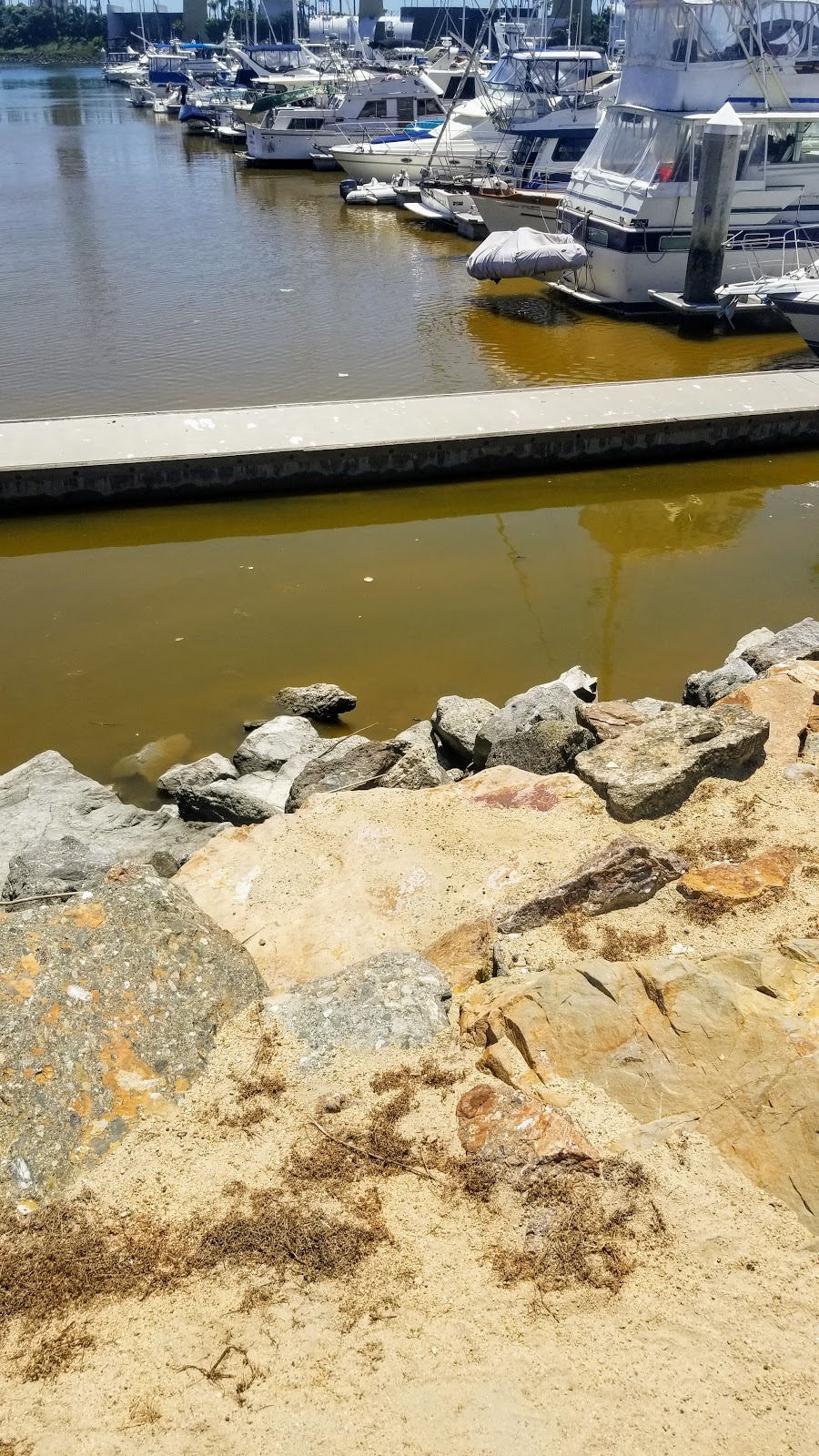
Also, it seems like Long Beach's west-side marina didn't get the memo that all this quarantining has been great for the environment:
Monday, May 11, 2020
Surviving the Great Dying
There is evidence that we're living through a mass extinction event, and I'm not referring to the pandemic. In general, we're losing dozens of species every year, and that's likely conservative in the estimate.
Anyway, the end of the Permian period, there was one of the greatest mass extinctions ever. So many species died off that the event is known as the Great Dying today. It happened around 252 million years ago, at the line between the historical eras of the Permian and the Jurassic. Enough land animals disappeared that the dinosaurs came into their own, and the rest we (as in the masses) kinda know about.
But, besides the animals that survived, some plants also survived. Here are two from my walk to the grocers:
In the background is a fern tree, an ancient pre-flowering plant, nearly half-a-billion years old. Next to it, in the foreground, is a cycad, a fibrous, palm-looking plant that isn't closely related to palms at all. Having developed over 300 million years ago, cycads survived the Great Dying, survived the dinosaurs, and survived the end of the dinosaurs.
And that's just out on the walk to the grocery store.
Also in the neighborhood is another survivor of the Great Dying:
Ginkgo biloba is a broad green leafed tree that isn't an angiosperm---it doesn't flower. It's sometimes known as a "shit-berry" tree, since the fruits of it smell like poop, or vomit. I usually smell barf, and the idea is that they spread all over the planet because the fruits smelled like carrion. Today ginkgo can be found all over the globe. They're hearty, strong, and, above all else, are survivors.
Another plant that's in our neighborhood is a magnolia. I've taken many pictures of them over the years, but I just learned something about them. They are angiosperms, and we know that they flower from any number of popular cultural references.
BUT, the magnolia is one of the oldest remaining angiosperms. Like, ancient. But, once you think about it, it makes a certain sense.
Check it out: the leaves are extremely tough and covered in wax. The flowers are large, and the core of the flower grows after the petals go away. It grows and grows, and eventually looks like pine cone. It even behaves as a pine cone eventually, as it matures and the red seeds finally avail themselves to the tree rodents in the neighborhood.
Not a survivor of the Great Dying, but pretty cool nonetheless.
Anyway, the end of the Permian period, there was one of the greatest mass extinctions ever. So many species died off that the event is known as the Great Dying today. It happened around 252 million years ago, at the line between the historical eras of the Permian and the Jurassic. Enough land animals disappeared that the dinosaurs came into their own, and the rest we (as in the masses) kinda know about.
But, besides the animals that survived, some plants also survived. Here are two from my walk to the grocers:
In the background is a fern tree, an ancient pre-flowering plant, nearly half-a-billion years old. Next to it, in the foreground, is a cycad, a fibrous, palm-looking plant that isn't closely related to palms at all. Having developed over 300 million years ago, cycads survived the Great Dying, survived the dinosaurs, and survived the end of the dinosaurs.
And that's just out on the walk to the grocery store.
Also in the neighborhood is another survivor of the Great Dying:
Ginkgo biloba is a broad green leafed tree that isn't an angiosperm---it doesn't flower. It's sometimes known as a "shit-berry" tree, since the fruits of it smell like poop, or vomit. I usually smell barf, and the idea is that they spread all over the planet because the fruits smelled like carrion. Today ginkgo can be found all over the globe. They're hearty, strong, and, above all else, are survivors.
Another plant that's in our neighborhood is a magnolia. I've taken many pictures of them over the years, but I just learned something about them. They are angiosperms, and we know that they flower from any number of popular cultural references.
BUT, the magnolia is one of the oldest remaining angiosperms. Like, ancient. But, once you think about it, it makes a certain sense.
Check it out: the leaves are extremely tough and covered in wax. The flowers are large, and the core of the flower grows after the petals go away. It grows and grows, and eventually looks like pine cone. It even behaves as a pine cone eventually, as it matures and the red seeds finally avail themselves to the tree rodents in the neighborhood.
Not a survivor of the Great Dying, but pretty cool nonetheless.
Subscribe to:
Posts (Atom)