Before heading to bed this Saturday, this February 29th, I thought I should go check out my old posts and see if I wrote anything on the other leap years.
When I saw that I had contributed on both leap years in question (2012 and 2016), I decided to stave off bed and write a little acknowledgement.
It was funny, reading those right before writhing this. In 2012 we'd been back from Corrie's birthday trip to Central America for a few weeks, and I was still working at the restaurant. In 2016 Corrie was pregnant and we'd just returned from a trip to San Diego.
Now, in 2020, it's Saturday night and I'm assed out---hard---with a second tiny kid and in a constant state of weary. I love it, all of it, for sure, but as of right now I'm so very tired. It's a different kind of tired, different that when Cass was on wake-up-every-three-hours duty for that month after birth. That was...something else.
Anyway, happy Leap Day!
Saturday, February 29, 2020
Tuesday, February 18, 2020
Doing the Right Thing Gets Difficult
My son had a thing, a minor routine medical procedure that the surgeon told me they do hundreds of times a year. "Routine" and "general anesthetic" don't usually go hand in hand in my imagination, and, just in case you weren't aware: general anesthetic means getting knocked out and fully unconscious.
It's way better to do this now, we were told, because it gets dangerous later in life, both for the procedure and for the chances that things develop poorly in the meantime.
This was the right thing to do.
But damn it if it didn't feel like the right thing in he moment.
He looked cute and happy and chilling and all once he relented and agreed to put on the hospital issue scrubs:
Which made what I knew was about to be happening all the more difficult and heartrending.
General anesthetic is the IV drip of sleepy knockout drugs that keep you under for the duration of the procedure, but they always have to start a person out with gas---knock out gas, nitrous oxide, AKA hippie crack.
My son is already recovering nicely, having refused pain meds (mostly) and ice (completely), and is happy to talk with anybody listening about his privates. And this is a great thing. It was the right thing.
And that's what I have to tell myself, since my experience was vastly different than his.
My son loves me and trusts me and, even as we battle often, I don't mind having a headstrong and confident boy. But, in my last moments being able to be with him in the OR, in my last moments before they shooed me out to go wait in a lobby where I could follow the progress by color coded numbers on a screen, those last moments were spent holding him down and forcing a mask of gas over his face.
He fought and fought, and held his breath like a champ. Eventually his eyes rolled back into his head and he sounded like he was hiccuping. It's always like that, dad, they told me as they walked me through the doors. I couldn't form thoughts.
They made me drop of the scrubs they'd given me, and I couldn't even talk. As I waited, a wreck, for the color code to change on the screen for over an hour, the only thoughts I had were: If this turns catastrophic, my last moments with him were gassing him out.
I nervously read a book (with the faraway monitor in my field of vision, keenly watching the color block) to keep from sobbing.
He won't remember. Won't remember any of it.
And me...I'll never forget.
Tuesday, February 4, 2020
My February Girls
Today is my wife, Corrie's, birthday. Yesterday she gave birth to a daughter, or second child. Now I have two February girls.
Having made it to the due date---January 30th---and sailed past it, was an accomplishment in itself. Our first baby, the extremely boyish boy Cassius, was five weeks early, and all the doctor-y folks we talked with mostly summarized our likely birth proceedings as, "Oh, don't worry, but that baby will be early, too."
That turned out to not be the case.
Not necessarily feeling it with our OB, we decided to change plans at week 37 or so, and had a series of "speed-dates" with a midwife we liked, and decided on a home-birth, mostly because our choices were limited.
The midwifery from 2016 that we'd planned to use with Cass had ended up not working out, and our opinion on the place had shifted by the end of it all. And since we were opting out of the OB and the same hospital that the Boy was born in, we were left thin of options besides home.
So, that was our new plan.
Sunday night rolls around. I finished my slides and papers for Monday, shaved, and joined a pregnant Corrie in bed. We went to sleep before 11:30. At 12:45 she was waking me up, asking me to get towels because her water had broken.
We got the bed ready for future amniotic leaks, I went back to my computer and set my substitute up, and we settled in to go back to sleep, Corrie pretty sure that we couldn't know how much time would be between the water breaking and the baby coming. It was now about 1:20.
As we laid back down, her body---which had been slowly cramping and contracting for weeks by this point---seemed to have a serious cramp, which was actually a real contraction. She breathed through it and said, "That...seemed like a real one."
Ten minutes later and another "real" one, and we texted the midwife. She texted back saying to let her know when they were five minutes apart. After another one, we started timing.
About forty minutes in, averaging eight minutes between contractions, a no-effing-around variety of contraction, they quickly picked up the pace, and started to come about ninety seconds apart. I anxiously texted the midwife again, asking her to head over.
She said she was a half-hour out. The time between her saying she was on her way and the next text, saying she was a half-hour out, may have been four minutes, but felt like twenty. I was standing around helpless, as Corrie was moaning and painfully uncomfortable for a minute every other minute. She said the contractions were getting "pushy," and there was some blood now showing up.
I texted again. The response I got was, "Call or face-time if it feels imminent and we're not there yet."
Okay. OKAY. I got this.
They arrived, Corrie moved to the bedroom proper, stayed on all-fours, and labored for about an hour before our daughter, Camille Adele, arrived. I caught her, but unassisted this time, and got to announce the sex.
Throughout all of it, Cass never woke up, despite being next door the whole time.
7 pounds 8 ounces, 21 inches long, grip like a welder and leg strength like a gymnast, our baby girl is something else.
Our Perfect Day
So, water broke at 12:45, baby came at 4:42, Cass woke up around 6:50. He was so excited; he'd been saying that he wanted a baby sister. We asked him if he wanted to go to school and tell everyone abut his new sister, or stay home with us and have a family day.
We were ecstatic when he said he wanted to go to school. That time we needed. We spent the rest of the day taking turns cuddling and napping with the young lady. Eventually I showered and went to get the Boy, made dinner, and went back to cuddling and sleeping.
It was a perfect day, a perfect birthing day.
Sunday, January 26, 2020
My Coats are Old
Our trip to the snow an hour and a half away allowed me to bust out my pea-coat. I was very excited about this.
[Let me first say that I don't want to have a full-on dialogue about the differences between jackets (items you wear in November and March) and coats (thicker items you wear in January and February, as both will be featured here.]
My pea-coat was something I wore in the coldest months in New York, and layered with a scarf, fleece, gloves and hat, I felt I could handle any weather.
Another nice thing was that it went with anything else I was wearing: jeans and hoodie or suit and tie.
Purchased in late 2006 or early 2007, it's my newest coat.
At 14 years old, it's my newest cold-weather outer wear.
Taking it to the mountains was something I was looking forward to, and it got me thinking about the jackets I wear regularly and the coats I wont let go of, their ages and circumstances under which I came to possess them.
The next newest jacket is a corduroy zipper ensemble I wear half the time during these mild southern California winters:
If I'm wearing jeans, dark pants, and/or no forcasted rain, I tend to wear this. I used to wear it with a scarf when it was necessary and I had a small soft one, also a skull cap, but not so much anymore.
It was a Christmas present in 2002. My mom got me and Dan and Norm each a different earth-tone color. Back in high school and beyond Norm and I would raid the closets of elders who'd been sent off to facilities for corduroy treasures: leisure suit sport jackets were the best, and by the time I made the dorms, my jacket had nearly disintegrated.
A few years later this corduroy had replaced it, it having been lost to the ages.
The next jacket I wear the other half of the time, if it's going to rain or if I'm wearing dressier clothes:
For a long time in San Luis it was simply my rain jacket: when I had to ride my bike in the rain from Oceanaire to school, I wore this, even as it was a little too warm.
It reminded me of a jacket my friend (and dorm-time idol) Alan would wear, and I liked the way it looked back at the time I came into possession of it.
I say it like that because I didn't purchase it.
We had a Halloween party at Oceanaire in 2001, and I only remember that was the year because when we moved the couch I found the local newspaper from September 12th wedged against the wall. After the party, nobody claimed the jacket, and I asked lots of people. So, I've been wearing this jacket from winter 2001 on.
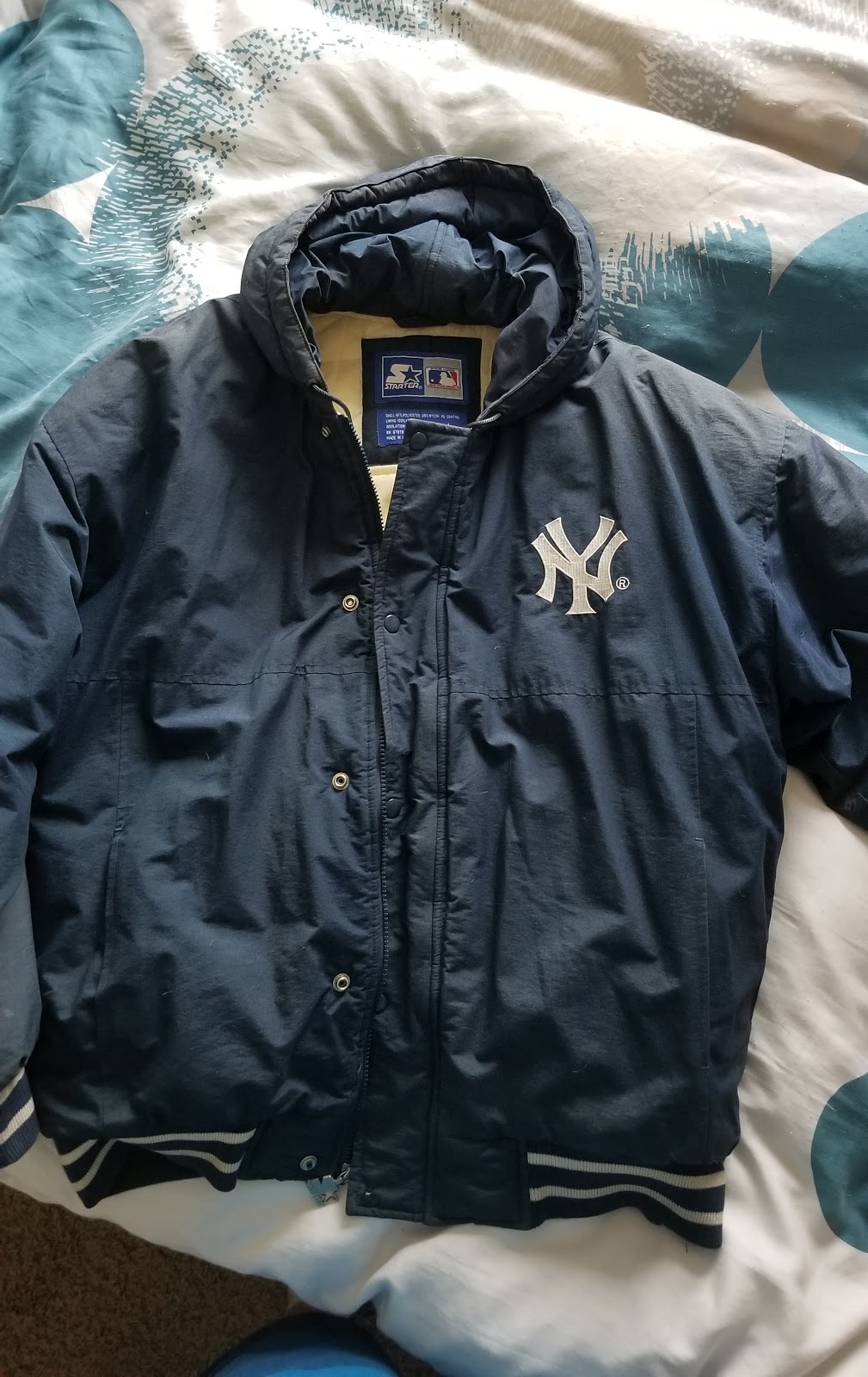
This brings me to my oldest coat, and something I haven't worn regularly since we left New York back in 2009. It may also be my warmest garment. This is my Yankee parka:
It's a classic '90s era Starter parka. It was another Christmas gift, only from 1992. I just did the math in my head: I was in 8th grade, because I had mentioned wanting one, then later mentioned how I didn't really want one, rather, I wanted a poncho. I hadn't realized it, but my folks had already gotten it, and that year I ended up getting both.
But I remember not yet being in high school, and seeing how '93-'94 was my first year, this had to be winter '92. This has been in my possession for 27 years and a month.
If it was ever cold enough, I would fully wear it.
My coats are old.
Friday, January 24, 2020
Just the Three of Us, For the Last Time
It's been a while since I got over to this, but I felt like I needed to do this before our family grew.
Some time after the new year, we drove from daycare pickup up to the mountain village of Wrightwood, only 90 minutes from our place in LA traffic. That means it's super close.
If you drive over to I-15, head north towards to Barstow and then Vegas, and turn left right outside of LA metro area, in ten minutes you'll be in Wrightwood, population 5000, elevation 6000, and with snow on the ground in January.
We arrived at dinnertime to our AirBnB, dropped our stuff off, and walked down to the street with the restaurants. We got pizza, took it to the brewery, which let us eat and me have a beer. (The pizza joint was take-out only.)
I haven't taken my pea-coat out since we moved to southern California in 2011, so this was pretty great.
The next day we walked to a diner for breakfast, and then played around in the snow for a bit:
In the front yard of the AirBnB was a likely grassy area covered in snow for us to snowman, as a transitive verb, "to snowman."
I think Corrie had more fun than Cass:
As we left the place at the appropriate time, we swiped a thrashed plastic sled from their recycle bin and returned to the gentle slope we played at after breakfast. Even Corrie braved the sled and slope, nine months pregnant and all.
Eventually we left for home, an hour and a half away, and 40 degrees warmer, all the way into the 70s.
We had a quick little snow trip, just the three of us, right before that time will be over. It was grand.
Wednesday, January 8, 2020
Just Sayin'
After finishing Disney+'s "The Mandalorian," I think it's pretty obvious that Din Djarin, the refugee saved and raised by a troop of Madalorian warriors and is the titular Mandalorian, is way cooler and more interesting than Boba Fett:
Boba Fett, above on the right, is the clone of disgraced Mandalorian bounty hunter Jango Fett, the one clone raised as a son instead of becoming a storm-trooper. Like his "father," he works for himself outside the good graces of other Madalorian subculture. Or so I hear.
Din Djarin, simply known as "Mando" throughout the 8 episodes, is a respected member of the guild, is such a thing exists, and lives by some sort of code.
Disney banked on the cool-ness factor of the Boba Fett mask, and let Jon Favreau craft an entertaining western television show, eight episodes deep, that may be the best Star Wars product since 1983.
Monday, January 6, 2020
Was it always this trippy? Revisiting Three Caballeros
I don't really want to write about the trippyness of the Three Caballeros, Disney's animated feature from 1944 that used some unused footage from the earlier, surprisingly successful in South America, Saludos Amigos, mixed love action and animation, used simplified backgrounds to save money, and let the animators go a little crazy.
The film is quite weird, mildly uneven, and has that psychedelic Mexican "third act" section that I probably should talk about later. My brother and I watched it regularly as kids---at least I remember that way, and with Disney+, I just recently watched it with my son.
I remember being fascinated with the categorical trio of avian ethnicities: Donald, and American duck; Jose, a Brazilian parrot; and Panchito, a Mexican rooster.
What I did want to write about this time were two things, one I completely forgot about until the audible cue came up, the other was something I noticed because of the elevated level of sophistication in my more mature ears.
The first was the song of the aracuan bird, a character and musical cue I had totally forgotten about:
For some reason, the annoying song and presence of this Woody Woodpecker-inspiration is something I love? Dearly? I guess? I can't explain it. On Youtube someone has pasted together a six-hour animated cycle of the annoying song scene, and while it would be a form of torture to be tied up and forced to listen to it, I think I could last longer than most before losing my faculties.
Instead of a full-order review of this animated project, I just wanted to keep this short and sweet. The aracuan bird, and this other observation:
When Donald meets Jose for the first time, in the middle third of the piece, there is about 25 to 30 minutes of regular samba beats, Brazilian music for a solid brick of time. The music shifts noticeably, and it should, when we head to Mexico with Panchito. It's all pretty informative for the era---the 1940s---and yet is characteristic, I'm sure, of specific regions in those countries.
But you hear them and think: "Brazil" or "Mexico."
At one point, Jose and Panchito are pushing a reluctant Donald to go dance with a pretty live-action lady at Mexican fiesta, and Donald complains that he doesn't know the dance steps. He gets up on the stage and the music changes: the band starts to play a jazzy dance number, with pianos and horns, and I realized: this is American music.
It's a noticeable shift, and in the movie theaters of the 1940s, anywhere in the world, all three of the music cues would have been obvious to listeners; samba, garricha, and jazz. In another room not watching but still able to hear, it's obvious.
I have a thesis about portrayals of the concept of "American" to foreign audiences, like Jiminy Cricket, or Joseph Cotten in The Third Man, or the kid who plays Han Solo in the stand-alone movie. And these music cues are another aspect of that thesis.
Subscribe to:
Posts (Atom)