This post could easily be called "The Intertwining of Three Mid-Market Baseball Teams' Histories", which is boring. As I was doing a little research about a piece about the Pacific Coast League and sports teams' names, every little tidbit added to this greater mosaic of history, which led to the breaking up of the original idea into at least three posts.
This particular post I feel could be expanded into a bigger thing. I just think the connections between the identities of the cities is ripe. This idea is bigger, anyway.
So I'll just shut up and get on with it.
There are some cities in America that get along with baseball. They enjoy it here and there, definitely when the team is doing well, but they never seem to get too bent out of shape about it. Dallas is like this. They like their Rangers, but it's almost secondary. Sometimes I get that feeling about Oakland as well. Maybe they just haven't had a lot to work with in a while--hell, they were home to the Oakland Oaks back in the day, so there was some reason Finley decided to move them there from KC.
The three cities I'm talking about in this post aren't those types of cities. These are the hard-core baseball cities. These have had historical teams ripped away only to replace them the next year (or a few years down the way), complete with the same name and team history. The teams acted as an extension of the city itself. They were institutions more than today's business venture identities.
These three cities are connected in a strange way that highlights what I spoke of in the "Introduction" piece.
The cities: Baltimore, Milwaukee, and St. Louis.
I put St. Louis last because they've had the most recent success; they just won the world series, won it in 2006, and lost it in 2004. That's three World Series appearances in ten years. That's more than the Yankees, Red Sox, and Rangers, the only other teams with multiple visits in that span (2002-2011).
Milwaukee I put second, since they're coming up, won their division, but just couldn't get all the way to the Fall Classic.
Baltimore has been in a prolonged funk since Jeffery Maier hauled in then rookie Derek Jeter's fly ball in the playoffs in 1996, causing an erroneous home run to be awarded to Jeter, spelling the eventual doom of the Orioles that year. The fans aren't really turning out. I've been reading about the beleaguered Baltimore baseball fan; they're screaming for new ownership to right the ship. They desperately want to return the franchise to it's rightful place of glory.
The Baltimore Oriole baseball team has a colorful history. They were fielding teams in Baltimore called the "Orioles" from before the Civil War. Over the course of a few decades they'd have success, major successes, and were invited to join the more major leagues many times. They refused as many times. The team would go through a rough patch, nearly go bankrupt, be sold and moved. This happened as well. Not every year was a championship year.
Soon after these moves, another organization would be built, and a new Oriole team would be established. Soon they'd be kicking butt, then they might falter. Before what we call the major leagues totally enslaved the minor league, there were two teams from minor leagues that repeatedly bested the teams from the lone major league (the National League) whenever they played: the Newark Bears and the Baltimore Orioles. Both were asked to join the NL, both refused. During a period of financial hardships, an Oriole owner accepted an invitation to join the upstart American League.
After just one year, he moved the team to New York, where it eventually became the Yankees. Baltimore would get another team through a move, another one of the charter members of the American league, but it would take a number of years, and other stops along the way.
Much has been made of the Dodgers and Giants leaving their boroughs in New York for California during the same winter, changing the baseball landscape and truly connecting a basically rural America through sport.
That, though, was not the first time a major league team headed west. The Philadelphia A's moved to Kansas City before the Dodgers and Giants, but before the A's the original abandoners of their East Coast origins were the Boston Braves.
The Braves moved from Boston to Milwaukee. Just as the Dodgers displaced the LA Angels and Hollywood Stars, and the Giants displaced the SF Seals, the Braves displaced the favorite sons of Milwaukee baseball, their very own minor leaguers. Care to guess on their name? If you said the Brewers, you've been paying attention or are a good guesser. Say what you will for Milwaukee baseball nowadays, but for almost the entire first decade the Braves were in Milwaukee, they led the entire major leagues in attendance. They even won the only World Series in both Milwaukee and Hank Aaron's history. (Way to go Hammer! Still more than Barry!)
The Braves in Milwaukee adopted the color scheme of the Brewers, navy and red. Even until recently the Braves have had two-tone caps, red bills with navy crowns and a white A, reminiscent of the white M used for both the Brewers and Braves.
A few years after the Braves vacated Milwaukee for Atlanta, a used car salesman named Bud Selig, a fervent lover of Milwaukee baseball, organized the purchase of the the strapped Seattle Pilots expansion team, and after only a single year in Seattle, they were relocated to Milwaukee. Their name? Do I have to tell you?
The Brewers were supposed to reclaim the navy and red color scheme from the original Brewer team, only the sale happened so fast and a reliable apparel company couldn't be found, so they just tore the Pilots logos off and sewed on Brewer logos. They simply adopted the Pilots' colors of gold and blue as their own.
But, see, the story of Milwaukee baseball goes back almost as far as the Orioles. The Brewers were a successful baseball team in Milwaukee during the 1880s and 1890s, and were extended an invitation to the new American League in 1901.
Isn't that wild? Two of the original franchises in the American League are the Baltimore Orioles and the Milwaukee Brewers, neither of which is still named that or located there.
In any case, something spooked the owner of the Brewers, because before the beginning of the 1902 season, after just one year of play in Milwaukee, the team was moved to St. Louis. Before the 1902 season in Milwaukee, after the American League team left, they easily fielded another team, named it the Brewers, and joined a minor league, most likely the one that they'd left to join the AL a year earlier. From 1902 to 1952 that same Brewer team was Milwaukee's baseball team, right up until the Braves came to town.
The Brewer team that moved to St. Louis adopted the name Browns, and became a staple of St. Louis sports. For the first few decades the Browns were in St. Louis, the goal of the owner's group was to run the Cardinals out of town. For a while they seemed to be working. Not that the Browns were winning a whole lot, but they were doing better than the Cardinals, which was all that they wanted. Any takers of the name choice? The Browns was a shortening of the original name for what turned into the Cardinals, the Brown Stockings.
The bitterness was palpable. People were still so upset that the Browns had changed into the Cardinals that they got another team and called them the Browns. they actively tried to destroy their opposition's franchise. It worked for a hot minute, then, with players like Dizzy Dean and Stan Musial, the Cardinals went on to be one of baseball's model franchises, where it remains today, having won the second most World Series in baseball history.
The Browns had their colorful owner Bill Veeck, who angered the rest of the group of stodgy owners through his clowning up the league. A well known example of a Veeck stunt was when he put a midget, Eddie Gaedel, up to bat in a game.
Eventually the other owners forced him to sell. He'd wanted to move the team, and the other owners wanted him out of St. Louis as well, but they wanted him just out. They let him sell, and the Browns were finally out of St. Loo, and any guesses as to where they went?
They were moved to Baltimore and became the Orioles that we have today. With such a rich tradition and history stemming from a brief single season in Milwaukee and a half century in St. Louis, it's almost strange that the Orioles have basically wiped that history from their teams identity. The Washington Nationals might celebrate Rusty Staub, a player from the (more or less) glory years as an Expo in Montreal, but you don't get a whole lot of history from Wisconsin or Missouri at Camden Yards, the home of the Orioles.
That history is irrelevant to the identity of the of the Baltimore baseball fan. That's one of the criteria for being a baseball hotbed; baseball tunnel vision.
In Milwaukee, they field a team called the Brewers. When a major league team comes along, they embrace them, but after they spurn you, you do what you do, and field a team called the Brewers.
In St. Louis they field a team just to run another team out of town, going so far as to name it the original team's original name. That there's enough support for baseball is during those times is what a hotbed's all about.
In Baltimore they wash away the history that has nothing to do with the history of the Baltimore Orioles.
Singular focus.
There truly is plenty in a name. Plenty.
Showing posts sorted by relevance for query what's in a name. Sort by date Show all posts
Showing posts sorted by relevance for query what's in a name. Sort by date Show all posts
Friday, December 2, 2011


What's in a name? Introduction
This is a little introduction to a larger piece about the names people assign to their sporting teams. Sports in America is for many men the only emotional connection they allow themselves to be tethered to, and this is a shame, since human beings obviously need emotional connections. Why else would sports be so popular the world over?
The nicknames for American sports teams, if we go back far enough, come from descriptions of people from those areas. This is a roundabout way to discuss the popularity of college football in the post-Civil War era. People from Ohio were called Buckeyes; people from Michigan were Wolverines; from Wisconsin were called Badgers; Gophers in Minnesota...I'm sticking with the Big 10 because they still retain those customs--rather, those customs have been so ingrained as to be thought of in the reverse. The major universities from those states--Ohio, Michigan, Wisconsin and Minnesota--adopted the names that midwest settlers had begun calling each other. A Hoosier is someone from Indiana. After a hundred years of the University of Indiana using "Hoosier" as its team's mascot, people have begun to think that calling someone a Hoosier means you're identifying their university of choice.
A few quick points seen through examples: in 1989 Charlotte, North Carolina was awarded an NBA expansion franchise. They started play in 1991 (I think), and their color scheme of teal and purple rocked the professional sports world. Their name: the Charlotte Hornets.
You might be surprised to learn that the main minor league baseball team that was a part of Charlotte's identity for almost a hundred years (almost all cities had their own team, in various levels of pro leagues) was named the Charlotte Hornets.
The sense this makes is kind of my point for the bigger post to follow. Owners tend to leave the naming of an expansion team up to the fans by way of voting on an approved set of names. This usually results in fans picking the name that has the most connection to teams of the past. Any guesses as to the name of Denver's main minor league team? It was the Rockies. How about from the same year, in Miami? They just switched back, actually, but the Miami Marlins originally was a team that played ball in the forties and fifties in Miami. How about the original LA team, the one here before the Dodgers showed up? The Angels.
Any guesses as to what the main Pacific Coast League San Diego baseball franchise was called? It was the Padres.The Padres, Rockies, Marlins, and Angels are all teams in today's major leagues, and their nicknames hearken back to their minor league origins.
Teams like the Hornets of Charlotte have a longer tradition for that nickname, similar to the Yankees. The Yankees started out in Baltimore, but when the moved to New York they were called the Highlanders. They were changed by the writers, as at the time nicknames were only nicknames and sports-page writers had the power to label the team as they felt, to the "Yankees" mainly because it could be shortened easier. "Yanks" was easier to print.
In any case, colonists were referred to as "Yankees" and "Yanks" by their British overseers, using a term with a Dutch background. Eventually people from the North were known as Yanks during and after the Civil War. Even later, during both World Wars, American soldiers were called Yankees, and now abroad, Yankees is synonymous with American, like Aussie, Kiwi, Springbok...The word made a type of sense to the New York City sports writer in 1907 to represent an American sports team in the City at the time.
A British naval officer, when complaining about the unruly people of the Carolina colony, and speaking of Charlotte specifically, likened it to a hornet's nest. The name Charlotte Hornets was used in a few different endeavors before the minor league baseball team came to be, but the nickname is one to which people in Charlotte feel connected.
But, fans can go horribly wrong in picking nicknames. Case in point (I'm not going to mention modern minor leagues of baseball, since they're absolutely fraught with awful, awful nicknames): the Washington Bullets. For those fans of the NBA, you'll recognize that there is no team called the Bullets anymore. This is correct. When Washington DC was in the top five for murder rate and total homicides in American cities, the city officials decided that the Bullets as a nickname was a little too insensitive.
The multiple choice they gave their residents is lost to me, but the final two, if I'm remembering correctly, were the Sea Dawgs and the Wizards. Both are horrible names for a major league franchise. The winner, the Wizards, is easily the worst nickname of the big four American sports.
Wednesday, June 18, 2014
Post One Thousand
One thousand posts. On this blog alone. Finally made it...
Okay, P1K Pop Quiz: What's wrong with this picture?

Don't worry if that picture and question are baffling; the answer will follow. It may not enlighten as much as you'd like, but it'll be there at the end.
I've been thinking about things coming full circle for some time now. A while back I was given a gift-card for the bookstore on campus where I am enrolled during this whole new adventure. But since I'm rarely ever on campus the gift-card languished away in my sock drawer for nearly a year.
Nearly a year? Dang...my internal sense of timing has been pummeled over the last thirteen months.
Anyway, I came across a video on Cracked's website about Harry Potter, or whatever, and watched the trailer. That was the first time I saw one of their creators doing an interpretation of Hunter Thompson. I even wrote a post about it a few posts ago, something about Artistic Sampling.
So far, it seems I've brought up three completely incongruous things.
In between seeing the HST portrayal and the related post, I made it to campus and happened to remember the gift-card. I moseyed to the bookstore and started perusing. I don't need textbooks or sweaters or shot glasses or coffee mugs. I don't need pennants or pencils or candy or soda. I guess I don't need books of a non-textbook variety, but that's where I headed.
I picked up a book about the Poincare Conjecture (it's math; about the shape of the universe), and a discounted copy of Outlaw Journalist, a biography of Hunter S. Thompson.
I haven't finished the HST book yet, but only because I'm not riding the trains of LA twice a day anymore and have too much to do around the house. BUT, it is proving to be an exciting read. A few things I didn't the know: the "S" stands for Stockton, and the pair, Hunter Stockton, as a first and middle name, come from his mother: her maiden name was Hunter and her mother's maiden name was Stockton. The "Dr." part of his personality came from a magazine send-away to become a "Dr. of Divinity"---seriously. Despite what's portrayed in the Johnny Depp 1998 film Fear and Loathing in Las Vegas, Hunter didn't get into cocaine until the mid to late '70s.
Another odd anecdote: on my "Artistic Sampling" post I have a photo I found of Hunter sitting with Oscar Acosta. Oscar is the gentleman with whom Hunter was trying to get away from Los Angeles that started the entire Fear and Loathing story. Anyway, Oscar was so livid after it was published that he threatened to sue Jann Wenner of the Rolling Stone for libel and wreck the magazine and Hunter's writing career; he single-handedly held up publication of the book for nearly a year. Both he and Hunter were nervous that if it was known that it had been Oscar that had accompanied Hunter during this felonious weekend that he may be disbarred.
In a personal letter to Hunter, it sounded as it his biggest complaint was that he was portrayed as a Samoan. And then, at the last second, in exchange for the dropping of the lawsuits, he demanded that a picture of both he and Hunter be on the dust jacket of the book. That picture from the sampling post is the one from the back cover, while they were at Circus Circus in Vegas. Probably high on mescaline, but you never know.
So...coming full circle...
I had a few ideas from a very hot week a while back that I started to give the gonzo treatment to. By that, what I mean is to cast a skeptical and searching eye onto the activities in question and...
...well, what does it mean to "give it the gonzo treatment?"
Fifteen years ago it would have meant "feature drugs and use of same heavily". And that's totally not what Hunter was all about. Sure, he used and abused everything he could get his hands on, but the focus wasn't on the substances, it was, in his case, on getting the story. He just happened to use and abuse everything he could get his hands on.
So that's when I started to find trouble with this project--the hot week and gonzo treatment. I have the scenes in question, the auxiliary characters set--but what's the deal? What is the perspective of this gonzo narrator and why is this perspective the case? That's when I really tried to figure out the center of the HST trip: what is the importance of altered states of consciousness? Is it the only way to achieve a rich and varied experience with the universe? Is that what Hunter was really all about?
And, most importantly for me, how will this shade my decisions on how to set the point of view of my protagonist? Can a story been given the gonzo treatment and not have a couple of fools driving fast all full of drugs with nowhere to go?
So, sometimes, while thinking about these things, I feel the need to jump on my bicycle and ride around Long Beach. On Monday of last week, after finishing grooming that bear I'd been working on for a while the Sunday before, I realized I had just a single day without any other obligations---no housework yet, no new-gig work yet, just me and my bike and my thoughts and my notebooks.
I set out to once again check out an area I was planning on writing a long blog post about (maybe even something longer). There is a tiny encampment underneath a large freeway overpass where there had once been many folks living in tents. I had planned on my piece being titled "Under the Bridge" (too cheeky, super-LA name, fo' rilly). It would profile the people who lived there, how they got there, what it was like, maybe even stay a night or two myself. I thought the idea could appeal to human-interest story fans as well as hipsters.
I went once and didn't get a chance to talk to anyone, and by the next time I made it over there, after recovering from my couch-summer, there was nothing left. I heard the cops pushed them off permanently.
So I return every once in a while.
Like this Monday I'm talking about. I rode my bike back over to the zone--it's just a quick ride, five or six thousand feet away, and mostly straight--just to let some ideas play out in my brain. The gonzo hot-week piece, my WiLA project, a specific scene in my novel--all these things running in my head at once. And then I saw that graffiti from the first picture.
Huh, I thought to myself. I'm not a master of tagging, and this barely qualifies in the artistic sense, but I'm also not uneducated on what certain things mean. And that graffiti has something wrong. I spotted it almost immediately and may have even said out loud, "Amateur?"
As I left the spot I went back to my thoughts and joined to LA River bikeway as it beelines for the harbor. Less than a minute ride away I rode by this, obviously the same handwriting, only this time the issue was fixed.

Can you see the difference; and if so, can you explain it?
Now, this leads me onto a related tangent: some people, myself included, have, on occasions, found themselves saying to somebody else about traveling to "the LBC" or meeting us "in the LBC" or some such. I've tried to excise that from my normal language, but I haven't really started calling people out on it yet.
It's obviously attributed to a line in a popular Sublime song, where it is actually used correctly, "...representin' the LBC..."
I think the valley girls and social drinkers who use it with the greatest frequency that I hear think that it means Long Beach City. In all honesty, it does roll off the tongue rather nicely.
The "LBC" is not a place: it stands for the "Long Beach Crips".
I guess that's more of a clue than a related tangent, but those don't have to be mutually exclusive.
Happy M! Happy 1000! Happy Thousandth Post!
Thanks for keeping up, if you do, and if you don't, thanks for making it to these last sentences.
Words just want to be read!
Okay, P1K Pop Quiz: What's wrong with this picture?
Don't worry if that picture and question are baffling; the answer will follow. It may not enlighten as much as you'd like, but it'll be there at the end.
I've been thinking about things coming full circle for some time now. A while back I was given a gift-card for the bookstore on campus where I am enrolled during this whole new adventure. But since I'm rarely ever on campus the gift-card languished away in my sock drawer for nearly a year.
Nearly a year? Dang...my internal sense of timing has been pummeled over the last thirteen months.
Anyway, I came across a video on Cracked's website about Harry Potter, or whatever, and watched the trailer. That was the first time I saw one of their creators doing an interpretation of Hunter Thompson. I even wrote a post about it a few posts ago, something about Artistic Sampling.
So far, it seems I've brought up three completely incongruous things.
In between seeing the HST portrayal and the related post, I made it to campus and happened to remember the gift-card. I moseyed to the bookstore and started perusing. I don't need textbooks or sweaters or shot glasses or coffee mugs. I don't need pennants or pencils or candy or soda. I guess I don't need books of a non-textbook variety, but that's where I headed.
I picked up a book about the Poincare Conjecture (it's math; about the shape of the universe), and a discounted copy of Outlaw Journalist, a biography of Hunter S. Thompson.
I haven't finished the HST book yet, but only because I'm not riding the trains of LA twice a day anymore and have too much to do around the house. BUT, it is proving to be an exciting read. A few things I didn't the know: the "S" stands for Stockton, and the pair, Hunter Stockton, as a first and middle name, come from his mother: her maiden name was Hunter and her mother's maiden name was Stockton. The "Dr." part of his personality came from a magazine send-away to become a "Dr. of Divinity"---seriously. Despite what's portrayed in the Johnny Depp 1998 film Fear and Loathing in Las Vegas, Hunter didn't get into cocaine until the mid to late '70s.
Another odd anecdote: on my "Artistic Sampling" post I have a photo I found of Hunter sitting with Oscar Acosta. Oscar is the gentleman with whom Hunter was trying to get away from Los Angeles that started the entire Fear and Loathing story. Anyway, Oscar was so livid after it was published that he threatened to sue Jann Wenner of the Rolling Stone for libel and wreck the magazine and Hunter's writing career; he single-handedly held up publication of the book for nearly a year. Both he and Hunter were nervous that if it was known that it had been Oscar that had accompanied Hunter during this felonious weekend that he may be disbarred.
In a personal letter to Hunter, it sounded as it his biggest complaint was that he was portrayed as a Samoan. And then, at the last second, in exchange for the dropping of the lawsuits, he demanded that a picture of both he and Hunter be on the dust jacket of the book. That picture from the sampling post is the one from the back cover, while they were at Circus Circus in Vegas. Probably high on mescaline, but you never know.
So...coming full circle...
I had a few ideas from a very hot week a while back that I started to give the gonzo treatment to. By that, what I mean is to cast a skeptical and searching eye onto the activities in question and...
...well, what does it mean to "give it the gonzo treatment?"
Fifteen years ago it would have meant "feature drugs and use of same heavily". And that's totally not what Hunter was all about. Sure, he used and abused everything he could get his hands on, but the focus wasn't on the substances, it was, in his case, on getting the story. He just happened to use and abuse everything he could get his hands on.
So that's when I started to find trouble with this project--the hot week and gonzo treatment. I have the scenes in question, the auxiliary characters set--but what's the deal? What is the perspective of this gonzo narrator and why is this perspective the case? That's when I really tried to figure out the center of the HST trip: what is the importance of altered states of consciousness? Is it the only way to achieve a rich and varied experience with the universe? Is that what Hunter was really all about?
And, most importantly for me, how will this shade my decisions on how to set the point of view of my protagonist? Can a story been given the gonzo treatment and not have a couple of fools driving fast all full of drugs with nowhere to go?
So, sometimes, while thinking about these things, I feel the need to jump on my bicycle and ride around Long Beach. On Monday of last week, after finishing grooming that bear I'd been working on for a while the Sunday before, I realized I had just a single day without any other obligations---no housework yet, no new-gig work yet, just me and my bike and my thoughts and my notebooks.
I set out to once again check out an area I was planning on writing a long blog post about (maybe even something longer). There is a tiny encampment underneath a large freeway overpass where there had once been many folks living in tents. I had planned on my piece being titled "Under the Bridge" (too cheeky, super-LA name, fo' rilly). It would profile the people who lived there, how they got there, what it was like, maybe even stay a night or two myself. I thought the idea could appeal to human-interest story fans as well as hipsters.
I went once and didn't get a chance to talk to anyone, and by the next time I made it over there, after recovering from my couch-summer, there was nothing left. I heard the cops pushed them off permanently.
So I return every once in a while.
Like this Monday I'm talking about. I rode my bike back over to the zone--it's just a quick ride, five or six thousand feet away, and mostly straight--just to let some ideas play out in my brain. The gonzo hot-week piece, my WiLA project, a specific scene in my novel--all these things running in my head at once. And then I saw that graffiti from the first picture.
Huh, I thought to myself. I'm not a master of tagging, and this barely qualifies in the artistic sense, but I'm also not uneducated on what certain things mean. And that graffiti has something wrong. I spotted it almost immediately and may have even said out loud, "Amateur?"
As I left the spot I went back to my thoughts and joined to LA River bikeway as it beelines for the harbor. Less than a minute ride away I rode by this, obviously the same handwriting, only this time the issue was fixed.
Can you see the difference; and if so, can you explain it?
Now, this leads me onto a related tangent: some people, myself included, have, on occasions, found themselves saying to somebody else about traveling to "the LBC" or meeting us "in the LBC" or some such. I've tried to excise that from my normal language, but I haven't really started calling people out on it yet.
It's obviously attributed to a line in a popular Sublime song, where it is actually used correctly, "...representin' the LBC..."
I think the valley girls and social drinkers who use it with the greatest frequency that I hear think that it means Long Beach City. In all honesty, it does roll off the tongue rather nicely.
The "LBC" is not a place: it stands for the "Long Beach Crips".
I guess that's more of a clue than a related tangent, but those don't have to be mutually exclusive.
Happy M! Happy 1000! Happy Thousandth Post!
Thanks for keeping up, if you do, and if you don't, thanks for making it to these last sentences.
Words just want to be read!
Wednesday, September 26, 2012
"The Red Violin" Anybody?
What's streaming Netflix best for if not exposing viewers to some absolutely random things? One film had a name and synopsis that provoked curious "Hmmph", and when Samuel L. Jackson's name showed up on the list, we were sold. The Red Violin was about a mysterious violin's historical connections, or something...at least according to the synopsis.
Why a mysterious violin piqued my interest, I can't tell you.
The movie, though, was pretty awesome. At least I found it pretty cool and enjoyable. The star was a violin, the famed last violin from a fictitious Busotti ,one of the Italian makers in Cremona (where Stradivarius worked)(in fact Busotti was a direct contemporary of Stradivarius). The story is framed by an auction in the present day and a tarot reading in Cremona, and the violin's long history populates the folks vying at the crying of the night's last lot.
The instrument's maker runs a workshop environment, and is a force. His wife is pregnant and has her fortune read by a servant, but becomes nervous about the nearing birth. The maker brings out a special violin, a perfect violin, that will be a present for his child, one he is sure will be a boy. This is 1681.
After a tragedy, we see the violin get a super red varnish, and become called the Red Violin, a thing people in the violin industry in the movie's present day know of as a mythical musical instrument (it's somewhat based on the Red Mendelsson, a specific Stradivarius violin).
This perfect violin gets gifted to a monastery where it's played by orphans for a hundred years before a weak and sickly child turns out to be a prodigy, and is taken to Vienna in an attempt to sell him off to one of the artsy Hapsburg creeps. After more tragedy, the trainer, mesmerized (like everyone who come into contact with the Red Violin), wants it to sell the violin, at least, and try and make up some of the money he lost on training the boy. This takes place after the French Revolution.
I don't want to really go into details over every stop for the violin, but I do want to say something about the languages spoken and the violin playing.
In the period spots, I liked very much that the language was relative and accurate. In Cremona in the 1680s everybody spoke Italian. In the 1790s in Vienna everybody spoke German, except the violin teacher, who was French and spoke only it at home, forcing the kid to learn French (the trainer was a royalist supporter in the revolution and had few friends in Vienna, and less back home). There's a scene with gypsies, and they speak Romany, the Indian sub-continent language of their origin; and a tense scene during Cultural Revolution in China is all in Chinese. It makes sense, for sure.
I think one of the reasons the filmmakers went ahead and did the languages accurately and subtitled it is because it was a French-Canadian production, and subtitles are a way of life.
The playing of a violin: Wow. Okay, I guess I'm a novice when it comes to classical instruments and the magical sound experts can regularly make them emit. Well, I'm a novice with most musical instruments. One guy, Joshua Bell, played all of the solos, and apparently is a modern master player.
The violin market, apparently, for the super-dooper violinists, is apparently made up of instruments made by a handful of guys from the years between 1650 and 1750. Prices range in the millions of dollars. Like, uh, I just bought this violin at auction for 2.7 million bucks, and I think I'll sell it when that (points to a different violin in a magazine/concert-photo) becomes available for sale. The histories for these instruments is almost as colorful as the movie, as many of the Stradivarius' exist and have been stolen, multiple times for many of them.
Now, if anyone has seen the movie, or plans on seeing it, see if you come to the same conclusion I did. Also, I guess what follows is a SPOILER. Samuel Jackson plays a collector and appraiser of violins, and is equally mesmerized by the Red Violin. He has a hunch that it is the famed Red Violin. He takes some of the red varnish for testing, and it turns out to be blood. That's what makes it red. Busetti made an applicator from his dead wife's hair, and used her blood. It's never explicitly said about what happened to the baby. Samuel Jackson's character get's in trouble for ordering so many tests, including DNA tests.
He ends up stealing the violin (something I called in the first few minutes), and calls his daughter on the ride to the airport telling her he's got something special for her.
I filled in the reasons that the movie skips. DNA tests are comparative. I think Busetti's wife was nervous for reasons other than her bad reading. I think she knew Busetti wasn't the dad, and that she'd been knocked up by a Moor. She died giving birth to a black baby, and her mitochondrial DNA was traced all the way down to Samuel Jackson's character---he's a descendant of the blood on the violin. That's my conjecture. He calls his daughter about it because she'll have the same MT DNA.
Saturday, January 25, 2014
Brief Background on Southeast Asia
I mention Southeast Asia in the title of this post because simply talking about French Indochina out of the context of the entire region would do a disservice to people who care to get a clear enough overview of the scene.
Southeast Asia has been historically known as Indo-China, and consists of the peninsula east of the Indian Subcontinent and south of Tibet and China, as well as the large archipelago south of Japan and north of Australia, known generally as the Malay Archipelago.
"Indo-China" as a rough moniker had been used because in general the area had been influenced heavily--in art, in language, in social customs and religious beliefs--by both the cultures of India and China.
Today the countries are lumped into two categories: Mainland Southeast Asia, and Maritime Southeast Asia. The mainland countries tend to have more in common with themselves than with the maritime countries, and the nature of these differences makes the separation all the more natural.
The mainland countries are: Burma, Thailand, Lao, Cambodia and Vietnam. While Malaysia and Singapore are technically on the mainland, both on the end of what's called the Malaysian Peninsula, they are considered closer to the maritime countries like Indonesia and the Philippines (and Brunei and East Timor) and are culturally listed in the maritime section.
1. Language Family Melting Pot
One of the main characteristics folks of white European ancestry will notice about the languages of China and Southeast Asia is their tonal properties. Tonal languages are very difficult for westerners to grapple with quickly or on a short trip because of the wild nuance needed for understanding. In these languages instead of our five vowel sounds, they tend to have between 25 and 30 recognized vowels, as each of our vowel sounds can be effected by voicing any one of five (or six) tonal changes. Think of it like Californian valley-girl speak: "I went to the store today? And the girl? Behind the counter? She to-tuh-lee overcharged me for..."
That upward lilt in English tends to point to a question, but in tonal languages that changes the vowel and the meaning of the word, sometimes drastically.
One thing I think is cool about all this is that these languages developed independently of one another. The Burmese language is from the Burman-Tibetan side of the Sino-Tibetan language family, the only language in Southeast Asia "directly" related to Chinese. Thai and Lao are in the Tai-Kadai family, which has many hill-tribe languages that are still used today. The Austroasiatic family houses both Vietnamese and Khmer (Cambodian). The Khmer written alphabet seems to be one of the oldest in the region, is based on the Indian and Sanskrit scripts brought over from India in prehistory (rather than the Chinese pictographs that serve as the visual basis for Korean and Japanese), and is itself the basis for both the Thai and Lao scripts.
2. Under the Thumb for a Millennium
Today a relatively skinny country takes up a very long coastline and goes by the name Viet Nam. We tend to write it as Vietnam, but they use the two words, and the special diacritical marks (that I don't have currently enabled on my blog-host). "Nam", in this instance for them means "south" and Viet is their identity, their people, and so, to them, their country is called "South Viet."
"Vietnam" as a name became popular in the 1920s during the struggle for independence from the French. For many centuries the land was known as "Annam". That was the name used by the Chinese for the strange and annoying wayward province south of their southern mountains.
Annam had always been a province filled with tough individuals who didn't take to colonization that well. After enough interbreeding, it was mostly subdued, and for over a thousand years the people of Annam, the Viet people, were under the rule of the Chinese occupation.
A thousand years of occupation.
Eventually, after many failed uprisings, a masterful and decisive victory was had by the Viet, now calling themselves the Dai Viet, or "Great Viet", and things were good. Mostly. For a while.
The millennium of Chinese rule lasted from the first Century BCE to the 1000s CE. Around this time the Burmese and Siamese (Thai) had been battling in the western jungles of this enormous peninsula while the most sophisticated empire, the Khmer, were setting up shop in their new capitol city of Angkor.
The Khmer were the Mayas to everyone else's Aztecs. They flourished with a taste for the arts, science, and grand building projects.
As the Dai Viet moved south along the coastline from the area surrounding today's Vietnamese capitol city of Hanoi, they battled and pushed the Cham people mostly off of their historical land.
On a map of today's Vietnam, you have the mountain highlands bordering China and surrounding Hannoi, then the long central coast curve, and the Mekong Delta in the south. When the Dai Viet finally got free of the Chinese, they only really held the top portion around Hanoi. The Cham, an Austronesian people, occupied the central coast, and the Khmer empire held the Mekong Delta.
By the time the Siamese finally and decisively sacked Angkor in the mid-1400s, the Dai Viet had mostly dispatched the Cham and were poised to grab the Mekong Delta from the crumbled Khmer.
Affecting the Cham and the region in between the rise (1000ish) and the fall (1500ish) of Angkor and the Khmer Empire was the Lan Xan kingdom. They were a Tai-Kradai people who were in what's almost exactly today's Lao and the best known example of the last time things not associated with opium or landmines made Lao a place of importance to somebody. (That's heartbreaking, by the way.)
The Vietnamese were insular and protective, the Siamese enjoyed the buffer that the fallen Khmer empire offered between them and the Viet, while they kept a wary eye to the west and Burma. Things were balanced, mostly, (unless you were Cham or Lao) until the French and British and Dutch took an interest in the region.
3. Sometimes it's About Timing and Good Diplomacy
The Thai are very proud and quick to point out that they were the only Southeast Asian country not to be colonized by Western Powers. Sometimes it's about timing.
Again with the Mayans...the Mayans were the intellectual and artistic powerhouse of Mesoamerica, only to be mostly a shell of their former selves by the time the Spanish arrived. Does that imply that they would have been a better fighter against the Europeans than the Aztecs? Of course not.
But in this region, the Khmer were the "premier", if you will, ancient society, and by the time the European powers arrived, they were a shell of their former selves.
The British promptly colonized Burma for their rubber trees and spices, while the French grabbed what they could on the other side, up to the Mekong River, as the region proved harder to subdue than originally wagered. The Dutch took most of the Malay Archipelago.
The Siamese kings and other diplomatic leaders were able to deftly play the insecurities of the British and French off of each other while keeping their own sovereignty intact. Good job, Thai folk.
4. Something Not Even the Nazi War-Machine Could Do
The Vietnamese people were a pain in the ass to the Chinese for a thousand years; they were a headache for the French before the Japanese occupied the region during WWII and they were a pain in the ass for the Japanese occupiers; they were finally successful in ousting the French after the end of WWII, declaring their independence with a document sent to major capitol cities around the world.
One particularly militaristic country decided that the Vietnamese declaration of independence was not acceptable--they had made the wrong choice of choosing a communist government. That country decided they were not going to stand by and witness more people living under communism, and they decided to wage a full-scale military action against the mostly peasant country.
That was us, in case you weren't following.
As a country, the United States military used everything at its disposal, every single thing short of nuclear weapons, against a skinny rural country full of barefoot kids, and failed.
The US used nuclear bombs against the Japanese, but not against the Nazis. So, in a sense, the Vietnamese are the only group that can accurately say: "We said GTFO to the American military, and then made it happen."
I have not had any close family members involved in the on-the-ground fighting in that conflict, but my in-laws were in the military during the conflict and saw overseas duty, but mostly stationed in Thailand or the Philippines.
That fact lead, I'm fairly certain, to a peculiar position: I've held the Vietnamese in very special regard for some time now, even to the point of obsessing.
If I was forced to choose a country that I might call my "hero" country, it would have to be Vietnam. All they ever wanted was to be left to their own devices and choices. They had a will that was stronger than the full military might of the wealthiest and most powerful nation in the history of the world.
To quote the late and great Howard Zinn: "When the United States fought in Vietnam, it was organized modern technology versus organized human beings, and the human beings won."
That might have tinted the goggles with which I viewed everything during this trip, but hey, that's life, baby.
Wednesday, July 27, 2011
What's the Catch?
On the long bike ride adventure I took last week to San Pedro and specifically after my crash, I felt like just seeing a few things and turning around to head home. Like I mentioned, my motivation was sapped. As I checked out something calling itself an "Antique Mall" (something they have with a strange regularity down here) (I looked over their cameras, chairs, dressers and books) I dabbed my now pouring sweat. I start sweating once I get off a bike. I was still bleeding, and quickly left the establishment. I noticed a sign attached to a store as I was unlocking my bike. It proclaimed the store (name escapes me) as the oldest continuously operating bookstore in the Southland. I took it as a sign, stopped unlocking my bike, and went inside.
It was a haggard collection of new releases of the sort you see at airport bookstores, magazines, local writers, nearly outdated comic books, and a display shelf of poorly-constructed looking paperbacks by authors I'd never heard of.
There have been visits by me to local indie record and book shops where I learn about new authors and publishing houses, places that are reputable publishers that may take unsolicited material. I'm not quite ready, as a writer, to have things ready for an agent, but I like to do fleeting research with publishers who publish things I think my closest material to being done most closely resembles.
Those visits have given me names of operations to look up later when I leave those establishments. Same thing here in San Pedro, with that collection of poorly-constructed looking paperbacks, a construction quality level that maybe should have tipped me.
The name of the publisher on the binding and inside each book was Publish America. When I got home, I looked up the company's website. It all sounded quite unreal. They are not a POD (print-on-demand) or vanity press. They make money the old-fashioned way--by selling your books. They don't charge their writers a fee, they send them checks. They pay advances once the manuscript has been accepted and the contract offer has been signed and returned.
Sitting in our new chair at the computer desk in our apartment I stared at my computer screen puzzled. This was an incredible set of statements. It seemed far too good to be true. They had editors who'd pour over your work line by line, at no cost to you. If I had material farther along, and had been striking out with agents and unsolicited material accepting houses, I might've been tempted to rush off and get something ready to send. Like I said, I'm not that close, and I haven't exhausted traditional avenues to getting noticed, so I decided to a bit of research. The catch had to be something...
I started by simply typing "publish america" into my Internet browser's Google search window, and without hitting "Enter" I examined all the choices it generates for you. "Publish america scams" was something like second on the list.
It didn't take long to find out that the way Publish America operates is like a sinister vanity press. According to the horror stories of authors who are unsatisfied with their treatment by PA, you're obligated to purchase a certain amount of copies for promotional purposes, they do not accept returns, they charge prices for books that are far too high, they claim to sell their writer's books in "brick and mortar" bookstores, which is true in the sense that a customer can walk in and have it ordered special ("selling in a bookstore" and "shelving it in a bookstore" aren't the same thing) but even then they've been known to rarely complete sales or transactions. They even have a difficult time producing reliable sales accounts for authors of their books. When you find a bookstore, like I had, that shelved Publish America books, you must be in a place that's either sympathetic to a specific writer, ignorant to the system, or run by PA writers themselves; most traditional bookstores don't stock any POD, vanity, or PA books.
A company that proclaims that they discover authors and give them their first chance, give their material the opportunity it deserves, they seem, in actuality, to hustle the writer and their family to purchase copies of their own book to recoup the costs associated with printing it. Most reputable publishers and literary agencies don't consider a PA published book a writing credit. Worst of all, they own your story and characters for seven years.
The amounts of things that have been published by Publish America that are heavy with obvious typos called into question their editing staff's credentials. A claim made by them on their site, that they turn down 80% of all manuscripts also came under fire when an already published writer, on an experiment, wrote thirty pages of material, changed the name of the protagonist on page twenty-two, then photocopied the last ten pages over and over again until his manuscript was 120 pages long.
He was offered a contract.
After Publish America made disparaging claims about science fiction books and writers, like the gentleman who made them look foolish with the book from above, a group of published sci-fi writers got together and decided to have some fun. The ringleader picked a few names and sent them to everybody in their cabal. Everyone was to write a separate chapter using the names, and they were to commit every young-writer mistake in the book--overwriting, tense mistakes, self-reference, you name it. They were also told not to communicate with each other, so each chapter would be from a different genre and style.
Once they got everything together, the randomly drew numbers from a hat to decide the order in which this mish-mash of garbage would go. Chapter 21 was left as eight blank pages because one writer wasn't on time with their submission. Chapter 12 occurs twice; chapters 4 and 13 are word-for-word copies of each other; they even used a computer program to jumble words and use punctuation to mimic written English, but in reality, reads like garbled gibberish. The characters change sexes and races without explanation.
This is almost like the Plan 9 from Outer Space of books, only it's deliberate. It's called Atlanta Nights.
Publish America accepted it and sent out the form letter saying as much. The hoax became apparent and in the news, and PA repudiated their acceptance the novel, trying to save face and keep up the image of their "traditional publisher" status.
The writers had such a good time with Atlanta Nights that decided to sell it, but from a vanity press, from where it deserves to be published. Here's a link to it if, like me, you're curious to see how bad really bad can be. I hear it's good for young writers, highlighting all the things that are mistakes, and helping them to vet their own material.
I've yet to purchase a copy, but I'm thinking about it.
Friday, June 12, 2015
Introducing Picasso Kahn
1.
KKAAAAAAAAHHHHNNNNNNNN!!!!!!!!!!!
2.
Netflix is an interesting gauge for solitary free time. Like, what do you watch when you're by yourself and have time? For me, late at night I tend toward old X-File episodes or a series of random horror/suspense movies that look shitty and that I can only stomach for maybe 10 minutes. I watch these then because Corrie doesn't like them.
On the occasion that I return home when Corrie wasn't working, or nowadays when she's got something on (which is rare), she tends to watch animated fare. She'll pick one of the endless computer animated films in Netflix's Kids/Fantasy category.
It's not that I don't like these types of movies in the same way that Corrie doesn't like the horror/thriller films I watch. But not disliking them doesn't mean I'd choose to watch them.
Frankly I'm always surprised upon watching. In most cases the surprise is pleasant.
One Friday I got home and she was watching a Belgium-produced film called "Thunder and the House of Magic". Now, a title like that has about a 0% chance of being watched by me. And missing it would have been a shame.
3.
I did miss the beginning of "Thunder and the House of Magic", and after hearing what it was, I am happy to have been absent for those initial ten or eleven minutes. The titular Thunder is an orange tabby kitten. The movie opens from his point of view, riding in a car. The car door opens and his favorite toy is tossed outside to the curb while he gives chase, leaving the car. The door slams behind him and the car drives away, abandoning him.
Horror movies, thriller movies, emotionally charged movies...none of those effect me, for some reason, like a kitten being abandoned on the side of the road. I'm trying to figure this out.
In any case, Thunder proves to be a resourceful kitten, eventually making a home with a magician and eventually saving the day. The plot is nicely convoluted, and there are many obstacles facing our young hero, but, of course, he prevails in the end.
Watching the movie and being a cat owner, one can see that the animators and producers both knew cats quite well, knew how they behaved and expressed themselves with their physicality, and tried their damnedest to realize that knowledge in this movie. That as a viewer I could tell all of that meant they were at least successful in that regard.
4.
It may have been watching "Thunder and the House of Magic", it may have just been time, but Corrie was now convinced to finally go out and get a companion for Tuxedo, a little brother if you will. This was January.
We decided to head to the rescue shelters and take a look, think about it, decide when would be a good time to pursue a new addition, try and get our apartment in order, and make it happen.
Corrie doesn't handle the dog sections of shelters well: "They all look so sad! I want to save 'em all!" It's endearing. I'm exactly the same way with the cats. I want to save all of them. I don't know why I'm not affected the same way with the dogs, because I love dogs as well. I'm just not emotionally spent after ten minutes at the dog shelter like I am with the cats.
It would seem to come down to which kitten Corrie would want, because I'll be fine with any of them, even ones that would obviously not be good mixes with Tux.
We found a few candidates at the shelters, talked about them, eventually heading home as Corrie found one last spot on her phone she wanted us to go and visit.
At this last place they had one absolutely terrified orange tabby kitten I was smitten with immediately, but it was pretty obvious his personality may not have been strong enough to make it living with ornery Tuxedo. At this same place Corrie found herself conversing with a loudly purring black and white kitten with a serious head tilt.
He liked to nuzzle and his purr was blender-like in volume. I thought at first he was purring as loud as possible to get this human attention, but I was wrong, (SPOILER ALERT) his purr is just that loud.
5. The Name Game
Like Tux, this kitten picked Corrie, and she needed to rescue him. His head tilt was due to a poorly managed inner-ear infection from a few weeks prior and it may clear up, we were told. His name was Pepper or Mo-Mo, but we could change it if we wanted.
Tuxedo came with a collar adorned with the name "Tuxedo" on the nickel-sized aluminum medallion, along with a phone number, after he was found on the side of a San Luis Obispo street, having been dispatched like Thunder. His name was 100% perfect: it is cool, can be shortened easily, describes what kind of cat he is, and describes exactly how he looks to boot.
During our first few months with Tux, we started adding names to his moniker, mostly trying to accommodate his evolving personality. I think this may be only me, but I settled on Tuxedo Cartman-Katt as an official name: "Cartman" because he's a manipulative liar and food monster like Eric Cartman from "South Park"; and "Katt" because of his propensity early on to nap with his tongue out like Stimpy, who's last name was Katt.
The vet claims his name is Tuxedo Sherwood.
So now, a decade later, we have a new kitten, and this one likes to nuzzle. I've never seen a kitten climb up to your face, sniff at your nose, then bury his tiny face in your neck:

To quote Monty Burns: How wretchedly adorable!
But we also have the head tilt to deal with. Turns out it was not going to go away. Check out this little video Corrie took:
It's silly cute. Corrie was thinking along the lines of "Sherlock", because of the inquisitive nature of the tilted head, but Sherlock is too close to Sherwood, and difficult to shorten. She suggested Picasso, because it was like one of his cubist paintings, and it can be shortened to 'Casso or even 'Cass. Why is shortening it so important?
Anyway, he came to us being called Mo-Mo, while Pepper was something from earlier and seemed too distant (for a four month old runt kitten? But still...), and we were compelled to make a change.
Related note: I was originally planning on calling this post "Cat People", with a stronger tie to the Thunder movie and how those producers had to have been cat people. But, while Corrie and I like cats, we're not so much "cat people" as we are "animal people who live in an apartment and can't agree on how small a dog will be acceptable." Then Tux went ill, this post got postponed...and postponed...and postponed...while we started to learn about Picasso, and the post's title changed.
6. Life Imitates a Horror Movie
And then life got interesting.
Picasso, newly minted newest member of the household, was doing kitten things. Tux was pissed off, making deep horn-like vocalizations displaying his disagreement with the situation, but mostly getting along.
After a few days, maybe a week, he stopped hissing and the angry horn-like bellowing, and it seemed like things were going to get better. He wasn't so pissy. This may work out, we said to ourselves.
Then one day Tux didn't want breakfast. Then dinner that night. Then breakfast the next day.
To repeat, Tuxedo didn't want anything to eat for three meals. When offered a piece of pork from my own plate, he demurred. WE HAVE A PROBLEM.
On top of that, he started looking uncomfortable, like he was constantly trying to choke back vomit. By day three, when he did barf, it looked like a huge green slug that wouldn't come all the way out. He hadn't used the box for peeing or deuce-dropping. He hadn't eaten in a few days. Cats not peeing is a certified emergency, and we knew that, so we headed to the vet.
What was up? Could it really be about the kitten? Tux'd seemed ready to accept the little bugger...
The vet took an x-ray and saw he was constipated something fierce and bloated with gas. They gave him an enema and me a $300 bill.
It was the next day, when Corrie was out at an after-work function (her own going-away party), where Tux had morphed.
He was hiding under the bed when I came looking for him. When I found him, I'll never forget his face: it had changed into something out of a horror movie. Later they told me it had become bloated due to his constant air-gulping. It was badly bloated and deformed, his mouth lay open, sagging and crusty, his eyes glazed over. This was not good. This was exactly what the vet wanted us to pay attention for. Back to the hospital with the little dude.
He needed to stay overnight. That turned into two nights. They weren't sure what was happening. I was oddly confident he wasn't going to be leaving us permanently, but Corrie was far more worried. Feeling helpless was the worst part. THIS IS A CAT AND NOT EVEN A HUMAN BABY. I started to see a bigger picture about fatherhood.
Meanwhile Picasso's nature was coming into focus. He desperately wanted to be around his brother, and even after getting Tux home from the vet and needing to sequester him, Picasso was unsure of what he could do:

His multi night stay at the vet gave us a $2k bill and more questions. And directions. Because of his bloated face and madly irritated throat, Tux needed to be "assist-fed". He also had five different meds that needed to be "assist-administered" at different times of the day and in specific orders.
Are you familiar with "assist-feeding" a cat? Essentially, you need a cat-food that is ridiculously soft, mixed with water, and able to be both drawn up into a ginormous syringe and shot out of the syringe down the throat of an angry and squirming cat. Corrie, newly done with working in Orange County, found herself in this role. Near the end of this horrific multi-times-a-day process, she and Tux had an unwritten understanding: he knew he needed the food, and that the act was as traumatic for her as it was for him.
Again, meanwhile, Picasso was too goddamn cute to pass up paying attention to, and he spent much time being doted upon by Corrie, in between the force-feedings and force-medicating. Also, it became apparent Picasso liked to TEAR SHIT UP. Here he is messing with Corrie's fifteen year old philodendron, aptly named Phil:

7. Corrie's the Real Superstar
In between all this, Tux being deathly ill and Picasso in DESTRUCTO-MATIC mode, she managed to study enough to pass her last ARE, eliminating the ticking clock of her seven nationally needed architectural exams. She's almost an architect! She only has the California supplemental exam, and then she'll be a licensed architect!
I'm so very proud of her. This could easily have been its own post, but time was never on my side in the six months of this year leading to now.
8. Tux Feeling Better; The Boys "Getting Along"
After a while Tuxedo was feeling better, eating on his own, but his voice still hadn't returned. The vet said that it would be the last thing to return. We weren't too upset, seeing as how Tux has long been known for his mouthy actions leading up to the two meals of the day.
But now there was another mouth to deal with, and occasionally the two would sit together long enough to pose for a picture:

Now may be a good time to reflect on the size issue: at first I was sure that Picasso was going to be substantially smaller than Tux, but only because Tux is a beast. It wasn't so much that Picasso was destined to be smaller, it was more that it's not fair to be gauged against such a large specimen. At least 'Casso's attitude and demeanor matched a beast far larger.
Pretty soon they were chasing each other all around the apartment. Tux finally was getting the exercise an older cat needed as well as some camaraderie. They "played" often, and by that I mean they bite, chew, and generally beat the hell out of each other, going at it pretty roughly, until Picasso screeches and Tux lets up. But Picasso is right back at it. They say cat play shouldn't be as rough as our boys get, and it has to do with who's training whom in the play, and because of Tux's aggression that Picasso won't learn easy-play. Um...okay. Not exactly sure how to manage that, so we just let them do their thing.
Afterwards, they pass out together for hours:

9. "Kahn" or "Stitch"?
If there is a writing instrument, tag of some kind, plastic label...anything actually made out of matter, it seems, floating around, Picasso has deemed it enemy of the state, and will try to destroy it. On top of being labeled THE DESTRUCTOR like Gozer in Ghostbusters, he turned out to be a fearless acrobat, jumping at bad angels and turning his tiny body into a torpedo of claws and soft, soft fur.
The bad angles are due to his depth perception issues related to his head tilt. It's cute and tragic. He manages like a champ, though.
Corrie and I likened him to the indestructible alien Stitch in Disney's Lilo and Stitch. But that didn't seem to capture his attitude as much as his physical daring-ness. That's when we finally settled on Genghis. Genghis Kahn, or the historical perception of said Mongolian leader, seemed to align perfectly with our little ball of energy.
Corrie was quick to defend Picasso, saying that Tuxedo was able to spend this age outside at our Palm Street place in San Luis, where he had two little buddies as well (Bullet and Cous-cous). So we didn't get to see the kitten-destructor mode of Tux. That's true, but Kahn fits as a moniker.
Picasso Kahn.
10. Five Pounds of Life Altering Change
Corrie mentioned at one point during this entire half-year of adjusting: "It's amazing how much 5 pounds can change your life."
Picasso has been that. And now he's getting bigger and won't be such a runt, and Tux has slowed down on his rough play, likely because he can't just throw lil' 'Casso around like he used to (and boy, how he used to). It seems like we found a good complement to Tuxedo.
This was also part of a larger master plan, one which I'll leave alone discussion of for the time being. Finding a pal for Tux and trying to adjust to cramped life in our beloved Long Beach apartment...
11.
One last thing to mention is the noticeable shift in pet-owner-ing styles Corrie has adopted. Ten years ago when Tux was brand new in our lives Corrie was loving yet stern. Tux needed the attitude adjustment. Nowadays, Corrie is a softie using the kid-gloves while I am the disciplinarian. Not that I wasn't with Tux, only that with Tux the needs of the situation were different.
Watching Corrie adjust her "caring-for" styles has been interesting. She's much more patient these days.
Oddly, I'm finding it hard to describe exactly the truth of the matter. She's just different. But that makes sense: we're different people than we were a decade ago, like everyone.
12. Time Gets Away
I wanted to post about getting a new cat before now. At first it was going to be tied in to "Thunder and House of Magic", but then Tux fell deathly ill. Later I was trying to figure out how process all of those tough emotions about the possibility of losing a beloved pet.
We dragged Tux to Kingston, then to Brooklyn and to Austin and back to California! He's better traveled than my charges; Corrie and I weren't even engaged when we got him---now we've been married for more than a half-dozen years. We expected at least another five-to-seven years with him, but those few weeks made his final exit a much more tangible thing.
Being able to celebrate a new addition was clouded over by difficult realities.
Work demands were constant and draining, and blog life took a seat way in the back of the bus.
Tux has recovered from that mess, but now he's chewed his ass nearly bald, and we're not sure what's up. We are sure, though, that we won't be going back to the vet until he stops eating: we don't need to throw another thousand dollars at a problem and get no answer.
Life rolls on. The boys play, they eat, sleep, frolic, bask in the sun, play some more, and sleep a whole lot more.
13. The Boys
When we first saw this, our hearts melted a little:

They'll be fine, right?

As their size gap diminishes, their camaraderie shifts...
Our furry boys...
Thursday, September 8, 2011
Quinine and Pine
Many plants on this planet have curative abilities for a slew of maladies. In Jeremy Narby's book The Cosmic Serpent, the writer relays his studies in the Amazon basin, learning the local natives' belief that their dreams tell them what plants to use to mix and make healing "potions". These potions aren't magic, of course, but they're quite excellent at curing whatever they're designed to cure, sometimes many years ahead of pharmaceutical companies, a few of which have people working in the area.
One idea Narby discusses--and concedes it could get him drummed out of the anthropological academia--is an interpretation of the native's explanation that our DNA tells our Amazon cousins what plants to use, and that communication takes place when the medicine men are under the influence of ayahuasca, a psychedelic brew made from local vines. The main ingredient in ayahuasca is DMT, an alkaloyd that's a building block in psilocybin, the magic component in "magic mushrooms".
In any case, the bark from cinchona trees from Peru, when mixed with sweetened water (to offset the bitter taste), was (and still occasionally is) used as an effective muscle relaxant. Another interesting thing this bark water does is stave off malaria. The main ingredient, chemically, as it were, is quinine.
When the Brits colonized India, malaria being the problem that it still is, they had to drink plenty of quinine. They carbonated it and called it "tonic water", as it was literally a health tonic. Would anyone like to guess what colonizing military men would do with a fizzy and horribly bitter drink?
Add gin, of course.
If you take neutral spirits from agricultural production and distill them a second time, and this time mix in the berries of the juniper pine tree, you get what we call "gin", a harsh concoction of rubbing alcohol and pine. Oh how we love it. Maybe I just mean "me" instead of "we".
The name almost certainly comes from genievre, French for juniper, so that pine taste is an essential characteristic.
In my time as being an alcohol-drinking person, I've gone through different phases of where my affections lie when it comes to cocktails, beers and wines.
My love of beer is great, and while I enjoy many different kinds, I tend toward ales over lagers, darks over lights, and I'll order any small brand I've never heard of before. In Texas I drank a fair share of Lone Star (The National beer of Texas), but only because it was cheap. In New York it was Ballantine Ale, which wasn't all that bad. In both of those cases cost and resources were issues, but my true affections lie with the high-end or small production product.
My appreciation of wine is also great, but I say appreciation and not "love" deliberately. After a rough patch when I was 19, I stayed away for more than ten years. Now I'm learning to appreciate more, and generally just learning more, which I like.
This post is more about my cocktail habits. When I was young and stupid I didn't really drink vodka mixed drinks. I still don't today. They're too smooth for me, to easy to mask, maybe. Maybe that says something about me.
I did drink a bit of gin and Dr Pepper, an old-fashioned GDP, before I backed off spirits in general for a half-dozen years or so. You could probably say that of anything, the GDP was my "drink" during those times.
The day I turned 21, I went into a bar and ordered for my first drink the same thing my dad told me he ordered on his first trip to the bar: a whiskey sour. (I wasn't carded.) It was hot sweet-tarts, and I had my new "drink". I drank whiskey sours for a while, until being accepted into a bar culture and scene that was the coolest bar scene I've been a part of. At McCarthy's they'd pour drinks that were strong, and I mean strong, and so I switched to Jack & Coke. The smallest amount of Coca Cola can affect the flavor of Jack Daniels in such a way as to make even the largest amount of spirit palatable.
Jack & Coke did me well most everywhere. People have heard of it, they don't need to ask what's in it, and it's respectable. Most everyone in our group ordered J&C then, and still order it today. In our group, the occasional shot will be Jameson, while Corrie tends toward Patron. I won't turn down Jaeger.
But, as happens in life, circles come around. At a NY Jets draft party in upstate New York everyone was drinking gin & tonics, and I joined in, having not even tasted gin since 1998. It was warm out and the drink, with it's bright quinine lime and pine flavor was quite refreshing.
I started regularly drinking the G&T as a cocktail a year later. I noticed that nobody would drink my gin. Now, as a stiff cocktail on my one day of drinking a week, the G&T does me well.
Quinine and pine...my history tied with the DMT drinking natives learning from their DNA...
I listened to mine; I learned from it; I am it. This just might be the most self-indulgent tripe-filled introduction to a long essay on DNA. I'm not sure that I'd agree with Narby's vocabulary or wording of his central thesis, that DNA educates beings to important things that would be helpful to those beings, but, in reality, the truth of the matter is a shadow of that thesis, or the thesis is a shadow of the truth.
Quinine and pine...a metaphor for the underpinnings of the human universe...health and self-destruction...learning from yourself and about your own connection to this rock...quinine and pine...
Thursday, May 14, 2026
Roundabout Way to Mokele-Mbembe
Oh jeeze, try to follow this stupefying line...
At Free Comic Book Day, I picked up this for nostalgia reasons:

Remember the show? I do. Cass asked me, What's this? And I said, besides a very cool David Mack cover, it looks like a comic based on a television show from the '80s that I remember fondly. I tried describing the show to him: a regular guy is given a super-suit by aliens and has difficulties controlling the powers as he navigates his new responsibilities. A super-hero show a bit ahead of its time.
But, it turns out, William Katt, the actor who played Ralph Hanley (originally Hinkley, but changed after the Reagan shooter, er, de-popularized the name), got involved in the production of this upcoming series. His face is so ably painted by David Mack right there.
I went and looked up some info on Katt, and was reminded about a movie where he played Sean Young's husband, and she was a biologist and explorer on the hunt for a monster in the African hinterlands.
Oh, yeah, I thought when I saw the name on Katt's filmography, I remember that movie. I was very fond of it, and was trying to describe a scene to Cass later: "So, there's an African dude, a local who's all sick, and they ask him what's wrong and he motions to his stomach, and then they ask him what he ate, and in the dirt he sketches it, his food---and it's a brontosaurus!"
Nevermind that Cass was like, "What?" and I remembered that we use terms like sauropod now instead of the recently abandoned 'brontosaurus,' but eventually he got the idea.
Sean Young plays an American researcher in search of mokele-mbembe in the movie titled "Baby: Secret of the Lost Legend." She and Katt end deep in the central African rainforest saving a baby sauropod, while the father is killed by a national military and the mother is caught.
It's silly and mostly forgotten today. But when I was looking up info on the movie, the name mokele-mbembe was hyperlinked to its own background, which was extensive.
Apparently, mokele-mbembe is similar to Bigfoot, the Yeti, or the Loch Ness monster, in that it's a cryptid, that is, a legendary animal that's unverified by current evidence. Instead of a hominid, it was described variously as larger than a hippo but smaller than an elephant, or half-elephant/half-dragon, or four-legged with a very long pointy-thing on it's face. That last one I think was translated by someone else as 'four-legged with a very long neck.'
It turns out that a few very serious expeditions to search for evidence of a living mokele-mbembe have been outfitted in the recent past, all with the thinking that the animal is a sauropod relative. And you may think: Okay...that's kind of...interesting.
But, it needs to be said: These expeditions were outfitted and funded by recent-Earth creationists, an apparently well-heeled group of very religious christians, either incidentally or purposefully ignorant to the realities of geology and deep time, who were trying to prove---by way of finding a living sauropod---that the Earth was only 5 or 6 thousand years old.
They were, um, unsuccessful in their expeditions.
Most historians of linguistics and the area think the legends that form the basis of mokele-mbembe are based on the black rhino, an animal that hasn't lived in the jungle areas where the stories come from since before written history. That at least passes the sniff test: big animal, once did share the space with humans, left before stories were written down so those stories had to pass by word of mouth and oral tradition...those dots are easier to follow.
Anyway, seems like a roundabout way to get to "once again irritated by purposefully ignorant religious people," but here we are. Maybe I'll show the kids the Baby movie, or the Greatest American Hero show, but both of those are only available on streamers like Tubi or Pluto.
So, there's that.
Yeah.
Saturday, March 26, 2016
Wondercon 2016
The timing worked out in a bizarre fashion. As it does for many of our exploits...
I finished telling my mother that a trip to Phoenix during my spring break would be a little too much work. It was funny: she wasn't expecting us to come and I wasn't really prepared to go, but Corrie wasn't sure what the last word had been between us (my mom and me) and that I should figure it out. Anyway, it got figured out, and we stayed put.
It was that next day at work when someone asked me if I was going to go to Wondercon this year. Hmm, I thought. My eyebrows shifted up and I asked, "Uhh, what's Wondercon?" Wondercon is the name given to the ComicCon conglomerate's convention in Los Angeles. The conglomerate operates the world's largest pop-culture conference in San Diego, and the one here in LA is smaller (barely), and far easier to get to during spring break--thanks Blue Line! No driving necessary.
I went the Long Beach Comic Convention back in 2012, but that was mainly because I heard about it the day before, I was out of work, and I could walk over to it, living less than a mile away from the convention center. It was nerd-heavy.
This was something else entirely.
When I saw the dates (3/25 to 3/27, Friday to Sunday) and the location (the LA convention center--right off the Blue Line, our train here in LB) and the price of a single day ticket, a single Friday ticket since I wanted to hang out with Corrie on Saturday, I was almost sold. When I saw that a company I care about was releasing a special edition that you could only get at Wondercon, I was closer to the sale. I've never gotten any cool comics that were special editions available only at shows, mostly because I don't really go to these kinds of shows.
It was when I saw the Ralph Steadman-inspired special edition cover that I decided to go for Friday, get my special book, and close out spring break with a Wondercon Experience. Here's the cover that inspired me:

This book, issue number one of "The Adventures of Archer and Armstrong", is not a title I would generally read. I love the idea, and the execution, I just don't have the time and energy. This is a buddy title: Armstrong is a seven-thousand year-old immortal who's only interest is to get loaded and get laid, which sounds like some folks I know had they been immortal. Archer is teenager raised in a strict bible-thumping household, and wasn't exposed to pop-culture during his militaristic training to fight the devil incarnate. It's a strange team-up and the concept, like many from this company, I'm into, but I don't really have time and resources for the books themselves.
Anyway, the availability of this copy, and the experience of going to a comic convention was too much to pass up. I purchased a single-day, Friday only pass, and planned to catch the train to downtown LA.
The train was faster than I had planned, but I was later getting to it that I had planned, so that was mostly a wash. Upon arrival I followed the crowd around the plaza to get my badge. Having purchased the ticket meant you get a QR code printout, and you were supposed to bring this to the place and pick up the badge. The badge had a tapping technology so you could come and go with just a tap of your lanyard card. That was nice. The stream of people on their way to get their badges was thick but moving swiftly. We cruised into a large mustering room that eventually led to the badge pickup. Here's the room:

I guess they were expecting a ton of people for this line over this and the next two days, but on this day at this time it wan't necessary. I walked by slower walking folks to get to an open badge guy, and he got me my gear quickly.
From there--picking up the badge and booklet (that had maps and goings on), I tried to find the main exhibition hall. The maps sucked. I asked around, finally, and the lady told me the way: "Outside, turn left, and look for the building."
She should have said "look for the line," since it was already thousands of people long. It was twenty-to-noon by this time, and it sounded like noon was the time that the main exhibition was opening, and standing in the sun, surrounded by awesome geeks, felt longer than it transpired in reality.
The line grew and grew behind, and eventually started moving. Twenty-thousand people in line, and I was the nicest dressed person there.
I only mention it because it will come into play later. This was a comic-book convention, with the vast majority of people wearing at least some form of nerdy t-shirt, if not a full on costume, which was being worn by between five and ten percent of the people. I wore a pair of gray slacks with my all-black Chucks (which look dressy from a distance) and a nice polo shirt. I was a little out of place, unless I was standing with a panel of creators.
Also, with the vast amount of young people around, I went into Mr. Sherwood mode right away. So I was dressed relatively nice and walking around with authority.
Anyway, the line moved quickly and we made it inside the exhibition hall a few minutes before noon. I raced over to the Valiant booth and was likely the first person to buy the copy from above. And here I was nervous it would be gone. As the time passed, the exhibition hall filled up, with both customers and vendors. Here's a blurry shot from early on, before it got too crazy:

When should I mention the fine chocolate bar I took along with me? Now? Later? Anyway, I halved it and ate each half at different times, which added to the wonder of this year's Wondercon. For me, anyway.
After I picked up the copy I wanted, I meandered about for a while. Valiant was giving a talk at 1:30, and I wanted to check it out, and that gave me a while to explore.
At conferences, like this one and the LB Comic Con back in 2012, I realized I take the time to learn about other companies, super tiny companies living on the margin, for whom selling a book at this spot is far more meaningful than for others.
It was during this time---after getting the Valiant special copy and before their talk---that I found a few super-tiny publishers to support. The first was a collection of aboriginal-American artists, Native stories with Native themes...mostly I got this as a gift for a baby that is very important to me, that is as yet unborn. It will have native blood, and this was for it. The second thing I bought was from a trio of girls, the creators and publishers of a magic infused universe. This wasn't any book I would read on my own, ever, but I liked the idea of a tiny company made up of flirty girls, girls who live in LA, and may be amenable to coming to my work and giving a talk. See how that works?
Eventually I made it to my Valiant talk, which was touted as a way to get introduced to the stables of titles. It just so happened that everyone in the room was a die-hard fan. There just weren't that many of us:

I only read two comics regularly, and one of them is from this company. On the powerpoint projection display above is X-O Manowar, their flagship character. He's their sci-fi title: a Visigoth abducted by aliens, ends up with an alien suit of armor, breaks free and returns to Earth two thousand years after he left, everybody he knew is dead, and he's the most powerful human. Half the aliens chasing him think he's their savior, the other half are hunting him as a sacrilege. I like the idea, but I don't read it.
I read their espionage title, which is the most complex narrative in comic form I've ever seen.
Anyway, they talked about their titles for a while, and ended with a giveaway: Go to the booth and use the code-word "X-O Manowar", and you will get a Gold copy of a title. The tiny crowd let out an audible murmur. Gold issue? Free?
I've never gotten my hands on a gold copy of anything before, but now looked like the time. I applauded when it was appropriate, and got up, determined to make it to the booth and get that gold issue, I took off. I was afraid there would be a run on it, but as I returned to the stream of comic con denizens, I realized there would be so few people showing up to grab the gold copy that I'm sure I could get mine.
I did, stammering the password like a buzzed imbecile, but still...It was the regular cover to the Archer and Armstrong #1, but this time with gold accents. Here it is with the other A&A#1:

It was around here that I decided it would be okay to leave. The chocolate bar was running strong and I had a cup of coffee and decided to look at the schedule. There was going to be a Bob's Burgers panel at 4pm, which was in a while. I enjoy Bob's Burgers and see it as the spiritual successor to the Simpsons. I started to feel a kinship for the tens of thousands of nerds I was surrounded by and figured I should do my part to be at this panel.
I found the room it was in, and, in the room next to it, when I looked more than an hour ahead of time, was a panel discussion about DC Comics and Hannah Barbera. I figured it would be a talk about the "Super Friends" cartoon.
It turned out to be about how DC Comics was updating and making new comics based on the Flintstones and Scooby Doo (et al). I had a seat near the front, and really enjoyed myself during the question and answer portion. The second person to ask questions was a walking stereotype: Asian, super-duper nerd, started his chance with, "So I have only two stupid questions..." He went on with a six minute soliloquy framed on the superiority of a TV show from the late 90s that they should be making comics about instead of the ones they chose. I think Jim Lee himself was there---he had no knowledge of this particular show and said as much. Awkward laughter before the dude goes on but doesn't get to question two before they gently forced him away.
The rest was similar fan love and fan-care-too-deeply-about. Once it finished, I headed to the can and then next door, to the show that on before the Bob's Burgers deal. There was a steady stream heading into this room that I caught the tail end of and created some separation from the crowd behind. The ushers were saying, "This is it, man, we gotta close that," but because of that separation, I sashayed in right as they said it but before they closed a huge door behind me.
The huge room was dark, save the stage with a standing moderator and four sitters. The people in ahead of me in line moments before dispersed to the right, deeper into the crowd. I followed the wall on the left, towards the stage. Far ahead, up near the front, on the aisle itself, was an open chair. I strolled right up to the front row, where the stage was almost too far to see clearly, but the video feed screen was dominating the landscape.
As I got closer, the person in the next seat over came into view. Long hair, feminine shape; blond hair, age unknown; wait...late twenties, and they were hard OR early forties and you keep fit. I sat and she smiled: long lashes and, yep: age.
There was a security guy a few feet from the seat. An older black man, he nodded as I sat, saying, "How do, how do..." I nodded back with a quiet, "Sir." The chick pulled out her phone.
I started to listen to the program, trying to figure out what it was. It seemed too much of a hassle at the time to try and pull out the booklet and search in the dark for the title. I just listened.
The panel consisted of four creatives types being asked questions by a horny nerd-chick who ran a popular web-site that sponsored many of the events this weekend. Two guys wrote for Scorpion, one wrote for Elementary, and the last was a showrunner for Limitless. At some point I was sure one of the Scorpion guys was staring at me, giving me the evil eye.
Did I sit next to his girl?
Staring at the screen in front of us I saw four heads: three staring straight ahead with three-quarter squints because of the lights and one staring off to his right, across the table and some where else. Check out some footage of comic-con panels and you'll see the same style footage: four people sitting at a table with mics in front squinting at the lights.
Only this guy was staring at me. I would look from the projection screen over to the stage, close by but off in the distance, and it appeared---every time I checked---that he was mugging me.
The questions ended, so did the show, and eventually the lights came up. I liked my seat and planned on staying there for the Bob's Burger deal. The girls next to me stood as the house lights came up. Production assistants and other show-biz back-stage folks came out the runway that turned out to be right next to my seat. The talent was heading back as the producers congealed to have a mini-meeting and touch base. The girls disappeared as I looked around.
RESERVED
That's what the cover said on the seat I was in. I looked down the row. Five RESERVE seats to my right. The entire row behind; the two tiny, fractional rows in front. All RESERVED.
A meeting was happening to my left, nearly in my lap. They all looked at me like, WTF? I didn't get up, I didn't say anything. I drank some water. They finished their shit and went backstage. I stayed put.
An announcement was made saying that there were passes at the door if you need to go to the bathroom, passes that you can use to return to the room, which was looking like it would be at capacity for the Bob's Burger panel.
This sounded good, but being by myself meant holding my spot would be more difficult. I decided to ask the security guy right there, "Sir, if I leave some stuff to go to the can, will it be okay right here?" He said, "Oh sure. No problem."
No problem. "Thank you, sir."
Being dressed nice worked out pretty well. Nobody bothered me and it seemed like I belonged. As the time passed, after I'd returned from the bathroom, I figured I'd answer any questions with, "Hey, I'm a Rookie of the Year and that guy told me to have a seat down here." No questions ever came.
As the time drew nearer, they asked the crowd to "raise your hand if you have an empty seat next to you." This put me in a strange position, seeing as how I knew nothing about the seats. But I raised my hand anyway.
A guy behind me called out, "Well, those seats are probably being saved for something, right?"
I turned and smiled at him. "Right? I dunno...." A guy with a head set on came over. "Raise you hand if you're next to open seats," he said into a mic.
I raised my hand again, having putting it down a moment before. "Even these seats?" the guy behind me asked, pointing to "my" seats.
"Even those," the guy said, as some high school kids came and sat down. Pretty sweet for them, I thought: barely get in the door, run around until the last second and get a front row seat. The guy behind was pissed, having been there from before I sat down during the last talk. His seat said RESERVED too. He shouldn't have been that pissed...
We got to see the voice talent of Louise, Tina, Linda, Teddy, and Gretchen. Linda, Bob's wife, is John Roberts' impression of his Bensonhurst-raised mother. Kristen Schaal plays Louise and Dan Mintz plays Tina, both with their regular voices.
A nugget of truth in that last sentence is that Dan Mintz, a dark haired man thirty-five years of age has a regular voice that is also the voice of Tina Belcher from "Bob's Burgers". The crowd went crazy hearing him say anything really. It got him flummoxed as well, that his voice caused such a reaction in the crowd. A grown man saying, "Well, uhh, it was mostly a group effort..." in a voice identical to that of a (beloved) teenage girl character...the crowd would go crazy, he would try to find something new to say...they would go crazy...on it went.
The majority of the questions went for Kristen Schaal. A fan-girl even had plush dolls she'd woven just for them, Schaal and Mintz, to which John Roberts (Linda) got rather irritated. These guys had more fun with, and used sharper tongues with, the questioners than the DC/Hannah Barbera group.
They showed clips to adoring fans and answered questions for longer than they talked. All in all it was pretty sweet.
Afterward I concluded that the I'd had the full Wondercon Experience and elected for the train ride back to Long Beach. All in all, it was a very cool Friday and a nice end to a nice Spring Break Week.
I got the special edition comic; I got the free super-edition comic; I saw the ultra nerd asking embarassing questions; I saw more Rey Skywalkers per capita than I was expecting; I saw the pop-TV-show cast of the day; and I got to support tiny random artistic ventures.
I even got a picture of someone levitating:

Here are some crowd shots to end it:

I finished telling my mother that a trip to Phoenix during my spring break would be a little too much work. It was funny: she wasn't expecting us to come and I wasn't really prepared to go, but Corrie wasn't sure what the last word had been between us (my mom and me) and that I should figure it out. Anyway, it got figured out, and we stayed put.
It was that next day at work when someone asked me if I was going to go to Wondercon this year. Hmm, I thought. My eyebrows shifted up and I asked, "Uhh, what's Wondercon?" Wondercon is the name given to the ComicCon conglomerate's convention in Los Angeles. The conglomerate operates the world's largest pop-culture conference in San Diego, and the one here in LA is smaller (barely), and far easier to get to during spring break--thanks Blue Line! No driving necessary.
I went the Long Beach Comic Convention back in 2012, but that was mainly because I heard about it the day before, I was out of work, and I could walk over to it, living less than a mile away from the convention center. It was nerd-heavy.
This was something else entirely.
When I saw the dates (3/25 to 3/27, Friday to Sunday) and the location (the LA convention center--right off the Blue Line, our train here in LB) and the price of a single day ticket, a single Friday ticket since I wanted to hang out with Corrie on Saturday, I was almost sold. When I saw that a company I care about was releasing a special edition that you could only get at Wondercon, I was closer to the sale. I've never gotten any cool comics that were special editions available only at shows, mostly because I don't really go to these kinds of shows.
It was when I saw the Ralph Steadman-inspired special edition cover that I decided to go for Friday, get my special book, and close out spring break with a Wondercon Experience. Here's the cover that inspired me:

This book, issue number one of "The Adventures of Archer and Armstrong", is not a title I would generally read. I love the idea, and the execution, I just don't have the time and energy. This is a buddy title: Armstrong is a seven-thousand year-old immortal who's only interest is to get loaded and get laid, which sounds like some folks I know had they been immortal. Archer is teenager raised in a strict bible-thumping household, and wasn't exposed to pop-culture during his militaristic training to fight the devil incarnate. It's a strange team-up and the concept, like many from this company, I'm into, but I don't really have time and resources for the books themselves.
Anyway, the availability of this copy, and the experience of going to a comic convention was too much to pass up. I purchased a single-day, Friday only pass, and planned to catch the train to downtown LA.
The train was faster than I had planned, but I was later getting to it that I had planned, so that was mostly a wash. Upon arrival I followed the crowd around the plaza to get my badge. Having purchased the ticket meant you get a QR code printout, and you were supposed to bring this to the place and pick up the badge. The badge had a tapping technology so you could come and go with just a tap of your lanyard card. That was nice. The stream of people on their way to get their badges was thick but moving swiftly. We cruised into a large mustering room that eventually led to the badge pickup. Here's the room:

I guess they were expecting a ton of people for this line over this and the next two days, but on this day at this time it wan't necessary. I walked by slower walking folks to get to an open badge guy, and he got me my gear quickly.
From there--picking up the badge and booklet (that had maps and goings on), I tried to find the main exhibition hall. The maps sucked. I asked around, finally, and the lady told me the way: "Outside, turn left, and look for the building."
She should have said "look for the line," since it was already thousands of people long. It was twenty-to-noon by this time, and it sounded like noon was the time that the main exhibition was opening, and standing in the sun, surrounded by awesome geeks, felt longer than it transpired in reality.
The line grew and grew behind, and eventually started moving. Twenty-thousand people in line, and I was the nicest dressed person there.
I only mention it because it will come into play later. This was a comic-book convention, with the vast majority of people wearing at least some form of nerdy t-shirt, if not a full on costume, which was being worn by between five and ten percent of the people. I wore a pair of gray slacks with my all-black Chucks (which look dressy from a distance) and a nice polo shirt. I was a little out of place, unless I was standing with a panel of creators.
Also, with the vast amount of young people around, I went into Mr. Sherwood mode right away. So I was dressed relatively nice and walking around with authority.
Anyway, the line moved quickly and we made it inside the exhibition hall a few minutes before noon. I raced over to the Valiant booth and was likely the first person to buy the copy from above. And here I was nervous it would be gone. As the time passed, the exhibition hall filled up, with both customers and vendors. Here's a blurry shot from early on, before it got too crazy:
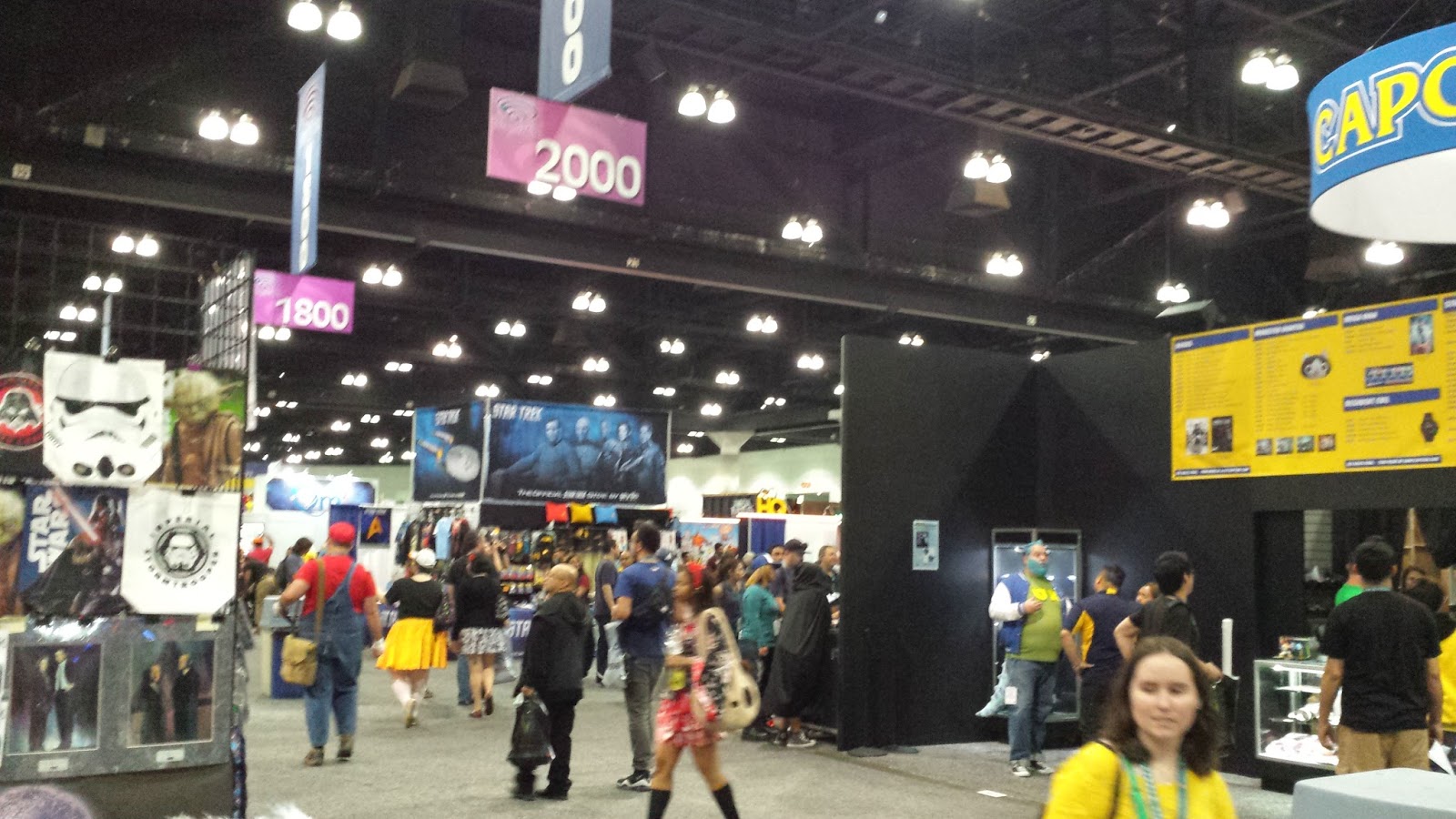
When should I mention the fine chocolate bar I took along with me? Now? Later? Anyway, I halved it and ate each half at different times, which added to the wonder of this year's Wondercon. For me, anyway.
After I picked up the copy I wanted, I meandered about for a while. Valiant was giving a talk at 1:30, and I wanted to check it out, and that gave me a while to explore.
At conferences, like this one and the LB Comic Con back in 2012, I realized I take the time to learn about other companies, super tiny companies living on the margin, for whom selling a book at this spot is far more meaningful than for others.
It was during this time---after getting the Valiant special copy and before their talk---that I found a few super-tiny publishers to support. The first was a collection of aboriginal-American artists, Native stories with Native themes...mostly I got this as a gift for a baby that is very important to me, that is as yet unborn. It will have native blood, and this was for it. The second thing I bought was from a trio of girls, the creators and publishers of a magic infused universe. This wasn't any book I would read on my own, ever, but I liked the idea of a tiny company made up of flirty girls, girls who live in LA, and may be amenable to coming to my work and giving a talk. See how that works?
Eventually I made it to my Valiant talk, which was touted as a way to get introduced to the stables of titles. It just so happened that everyone in the room was a die-hard fan. There just weren't that many of us:

I only read two comics regularly, and one of them is from this company. On the powerpoint projection display above is X-O Manowar, their flagship character. He's their sci-fi title: a Visigoth abducted by aliens, ends up with an alien suit of armor, breaks free and returns to Earth two thousand years after he left, everybody he knew is dead, and he's the most powerful human. Half the aliens chasing him think he's their savior, the other half are hunting him as a sacrilege. I like the idea, but I don't read it.
I read their espionage title, which is the most complex narrative in comic form I've ever seen.
Anyway, they talked about their titles for a while, and ended with a giveaway: Go to the booth and use the code-word "X-O Manowar", and you will get a Gold copy of a title. The tiny crowd let out an audible murmur. Gold issue? Free?
I've never gotten my hands on a gold copy of anything before, but now looked like the time. I applauded when it was appropriate, and got up, determined to make it to the booth and get that gold issue, I took off. I was afraid there would be a run on it, but as I returned to the stream of comic con denizens, I realized there would be so few people showing up to grab the gold copy that I'm sure I could get mine.
I did, stammering the password like a buzzed imbecile, but still...It was the regular cover to the Archer and Armstrong #1, but this time with gold accents. Here it is with the other A&A#1:

It was around here that I decided it would be okay to leave. The chocolate bar was running strong and I had a cup of coffee and decided to look at the schedule. There was going to be a Bob's Burgers panel at 4pm, which was in a while. I enjoy Bob's Burgers and see it as the spiritual successor to the Simpsons. I started to feel a kinship for the tens of thousands of nerds I was surrounded by and figured I should do my part to be at this panel.
I found the room it was in, and, in the room next to it, when I looked more than an hour ahead of time, was a panel discussion about DC Comics and Hannah Barbera. I figured it would be a talk about the "Super Friends" cartoon.
It turned out to be about how DC Comics was updating and making new comics based on the Flintstones and Scooby Doo (et al). I had a seat near the front, and really enjoyed myself during the question and answer portion. The second person to ask questions was a walking stereotype: Asian, super-duper nerd, started his chance with, "So I have only two stupid questions..." He went on with a six minute soliloquy framed on the superiority of a TV show from the late 90s that they should be making comics about instead of the ones they chose. I think Jim Lee himself was there---he had no knowledge of this particular show and said as much. Awkward laughter before the dude goes on but doesn't get to question two before they gently forced him away.
The rest was similar fan love and fan-care-too-deeply-about. Once it finished, I headed to the can and then next door, to the show that on before the Bob's Burgers deal. There was a steady stream heading into this room that I caught the tail end of and created some separation from the crowd behind. The ushers were saying, "This is it, man, we gotta close that," but because of that separation, I sashayed in right as they said it but before they closed a huge door behind me.
The huge room was dark, save the stage with a standing moderator and four sitters. The people in ahead of me in line moments before dispersed to the right, deeper into the crowd. I followed the wall on the left, towards the stage. Far ahead, up near the front, on the aisle itself, was an open chair. I strolled right up to the front row, where the stage was almost too far to see clearly, but the video feed screen was dominating the landscape.
As I got closer, the person in the next seat over came into view. Long hair, feminine shape; blond hair, age unknown; wait...late twenties, and they were hard OR early forties and you keep fit. I sat and she smiled: long lashes and, yep: age.
There was a security guy a few feet from the seat. An older black man, he nodded as I sat, saying, "How do, how do..." I nodded back with a quiet, "Sir." The chick pulled out her phone.
I started to listen to the program, trying to figure out what it was. It seemed too much of a hassle at the time to try and pull out the booklet and search in the dark for the title. I just listened.
The panel consisted of four creatives types being asked questions by a horny nerd-chick who ran a popular web-site that sponsored many of the events this weekend. Two guys wrote for Scorpion, one wrote for Elementary, and the last was a showrunner for Limitless. At some point I was sure one of the Scorpion guys was staring at me, giving me the evil eye.
Did I sit next to his girl?
Staring at the screen in front of us I saw four heads: three staring straight ahead with three-quarter squints because of the lights and one staring off to his right, across the table and some where else. Check out some footage of comic-con panels and you'll see the same style footage: four people sitting at a table with mics in front squinting at the lights.
Only this guy was staring at me. I would look from the projection screen over to the stage, close by but off in the distance, and it appeared---every time I checked---that he was mugging me.
The questions ended, so did the show, and eventually the lights came up. I liked my seat and planned on staying there for the Bob's Burger deal. The girls next to me stood as the house lights came up. Production assistants and other show-biz back-stage folks came out the runway that turned out to be right next to my seat. The talent was heading back as the producers congealed to have a mini-meeting and touch base. The girls disappeared as I looked around.
RESERVED
That's what the cover said on the seat I was in. I looked down the row. Five RESERVE seats to my right. The entire row behind; the two tiny, fractional rows in front. All RESERVED.
A meeting was happening to my left, nearly in my lap. They all looked at me like, WTF? I didn't get up, I didn't say anything. I drank some water. They finished their shit and went backstage. I stayed put.
An announcement was made saying that there were passes at the door if you need to go to the bathroom, passes that you can use to return to the room, which was looking like it would be at capacity for the Bob's Burger panel.
This sounded good, but being by myself meant holding my spot would be more difficult. I decided to ask the security guy right there, "Sir, if I leave some stuff to go to the can, will it be okay right here?" He said, "Oh sure. No problem."
No problem. "Thank you, sir."
Being dressed nice worked out pretty well. Nobody bothered me and it seemed like I belonged. As the time passed, after I'd returned from the bathroom, I figured I'd answer any questions with, "Hey, I'm a Rookie of the Year and that guy told me to have a seat down here." No questions ever came.
As the time drew nearer, they asked the crowd to "raise your hand if you have an empty seat next to you." This put me in a strange position, seeing as how I knew nothing about the seats. But I raised my hand anyway.
A guy behind me called out, "Well, those seats are probably being saved for something, right?"
I turned and smiled at him. "Right? I dunno...." A guy with a head set on came over. "Raise you hand if you're next to open seats," he said into a mic.
I raised my hand again, having putting it down a moment before. "Even these seats?" the guy behind me asked, pointing to "my" seats.
"Even those," the guy said, as some high school kids came and sat down. Pretty sweet for them, I thought: barely get in the door, run around until the last second and get a front row seat. The guy behind was pissed, having been there from before I sat down during the last talk. His seat said RESERVED too. He shouldn't have been that pissed...
We got to see the voice talent of Louise, Tina, Linda, Teddy, and Gretchen. Linda, Bob's wife, is John Roberts' impression of his Bensonhurst-raised mother. Kristen Schaal plays Louise and Dan Mintz plays Tina, both with their regular voices.
A nugget of truth in that last sentence is that Dan Mintz, a dark haired man thirty-five years of age has a regular voice that is also the voice of Tina Belcher from "Bob's Burgers". The crowd went crazy hearing him say anything really. It got him flummoxed as well, that his voice caused such a reaction in the crowd. A grown man saying, "Well, uhh, it was mostly a group effort..." in a voice identical to that of a (beloved) teenage girl character...the crowd would go crazy, he would try to find something new to say...they would go crazy...on it went.
The majority of the questions went for Kristen Schaal. A fan-girl even had plush dolls she'd woven just for them, Schaal and Mintz, to which John Roberts (Linda) got rather irritated. These guys had more fun with, and used sharper tongues with, the questioners than the DC/Hannah Barbera group.
They showed clips to adoring fans and answered questions for longer than they talked. All in all it was pretty sweet.
Afterward I concluded that the I'd had the full Wondercon Experience and elected for the train ride back to Long Beach. All in all, it was a very cool Friday and a nice end to a nice Spring Break Week.
I got the special edition comic; I got the free super-edition comic; I saw the ultra nerd asking embarassing questions; I saw more Rey Skywalkers per capita than I was expecting; I saw the pop-TV-show cast of the day; and I got to support tiny random artistic ventures.
I even got a picture of someone levitating:

Here are some crowd shots to end it:

Subscribe to:
Posts (Atom)